Lecture 16
Many particles, conservation of momentum and collision
In
physics we often speak about a “classical object.” This is an object
that satisfies Newton’s 2nd law,  .
So, all objects that we consider in this course are classical objects. [Note
that atoms in hydrogen molecules or NaCl molecules are not classical objects.
In some examples/problems, we just pretended that they were. That pretension
turns out to be OK as long as the simple description of
the stable equilibrium or the bond length goes, but is ultimately unforgivable
in view of other quantum mechanical properties of atoms and molecules.] These are big objects –
roughly speaking big enough for us to see – that move much more slowly in
comparison to light. Once we have a classical object, a collection of a few
classical objects also satisfies Newton’s law. For example, we saw that the
angular momentum was conserved in a system of objects, which consist of a merry-go-round,
a boy and a girl. Not only this, each one classical object can be divided into
many parts (like in calculus) each of which is another classical object. In
short, Newton’s law is inherently a law about many particles, whether “particle”
means separate classical objects forming one compound object or parts of a
single object.
.
So, all objects that we consider in this course are classical objects. [Note
that atoms in hydrogen molecules or NaCl molecules are not classical objects.
In some examples/problems, we just pretended that they were. That pretension
turns out to be OK as long as the simple description of
the stable equilibrium or the bond length goes, but is ultimately unforgivable
in view of other quantum mechanical properties of atoms and molecules.] These are big objects –
roughly speaking big enough for us to see – that move much more slowly in
comparison to light. Once we have a classical object, a collection of a few
classical objects also satisfies Newton’s law. For example, we saw that the
angular momentum was conserved in a system of objects, which consist of a merry-go-round,
a boy and a girl. Not only this, each one classical object can be divided into
many parts (like in calculus) each of which is another classical object. In
short, Newton’s law is inherently a law about many particles, whether “particle”
means separate classical objects forming one compound object or parts of a
single object.
Center of mass and its importance
For a many particle system, the center of mass is an important concept. We defined it before, but here it is, one more time.
|
|
|
(16.1) |

Here,  is the total mass. Since the
continuous case can be considered as an essentially discrete case also,
throughout this lecture note, we will use the first form. However,
mathematically, it is just as easy to use integrals instead of sums in all
equations of this lecture note.
is the total mass. Since the
continuous case can be considered as an essentially discrete case also,
throughout this lecture note, we will use the first form. However,
mathematically, it is just as easy to use integrals instead of sums in all
equations of this lecture note.
Why is the center of mass
important? First, consider the total momentum of the system,  .
Because
.
Because  ,
by taking the time derivative of both sides, we would get
,
by taking the time derivative of both sides, we would get 
|
|
|
(16.2) |


So, the total momentum is just the total mass times the velocity of the center of mass.
Let’s take
a second to really appreciate this fact. The system (or a compound object) that
we are considering here may be “a space shuttle with astronauts moving about
doing their jobs in and around it,” “a merry-go-round with several kids
jumping up/down/in/out-of it,” or “the solar system consisting of the Sun plus
planets, moons and asteroids.” No matter what may be happening between
different parts of a compound object, though, the total momentum is simply
given by  !
!
Here is another equation of importance.
|
|
|
(16.3) |

Here,  is
the net external force.
This equation is not necessarily a new equation, but now may feel more
informative since we have now defined the notion of the center of mass
explicitly. In this course, we’ve been busy describing motions of baseball,
skateboarder, and spit of archer fish, and so on and so forth. What we’ve been
doing was actually describing the motion of a center of mass, just as described
by Eq. (16.3). As before, is
the net force. More precisely speaking, is
the net external force. Recall that net means total. Why only
external? Because all internal forces are paired and they cancel out by
Newton’s 3rd law.
is
the net external force.
This equation is not necessarily a new equation, but now may feel more
informative since we have now defined the notion of the center of mass
explicitly. In this course, we’ve been busy describing motions of baseball,
skateboarder, and spit of archer fish, and so on and so forth. What we’ve been
doing was actually describing the motion of a center of mass, just as described
by Eq. (16.3). As before, is
the net force. More precisely speaking, is
the net external force. Recall that net means total. Why only
external? Because all internal forces are paired and they cancel out by
Newton’s 3rd law.
 Again,
let us take a pause, and appreciate the meaning of Eq. (16.3). Take the example of a space
shuttle, with astronauts doing all kinds of things in and around it. The space
shuttle may be doing a spin around its center of mass. According to Eq. (16.3), whatever these motions may be,
the center of mass moves like a point particle with the total mass (shutttle +
astronauts) under the influence of external forces only! Thus, as far as the motion
of the center of mass (“average motion”) is concerned, it is utterly
unimportant what the astronauts are doing or whether or not the shuttle itself
is spinning around its center of mass. The only thing that is important for
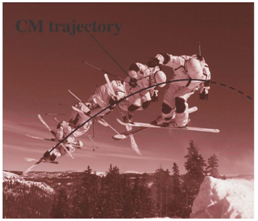
the “average motion” is the external force. Another example is a ski jumper,
as shown in the image. The jumper may be moving limbs and skis in complicated
ways. No matter. The center of mass follows a trajectory that is determined
only by external forces (gravity and air resistance).
Again,
let us take a pause, and appreciate the meaning of Eq. (16.3). Take the example of a space
shuttle, with astronauts doing all kinds of things in and around it. The space
shuttle may be doing a spin around its center of mass. According to Eq. (16.3), whatever these motions may be,
the center of mass moves like a point particle with the total mass (shutttle +
astronauts) under the influence of external forces only! Thus, as far as the motion
of the center of mass (“average motion”) is concerned, it is utterly
unimportant what the astronauts are doing or whether or not the shuttle itself
is spinning around its center of mass. The only thing that is important for
the “average motion” is the external force. Another example is a ski jumper,
as shown in the image. The jumper may be moving limbs and skis in complicated
ways. No matter. The center of mass follows a trajectory that is determined
only by external forces (gravity and air resistance).
Finally, the following equation
can be derived for the total kinetic energy  .
.
|
|
|
(16.4) |


Here,  ,
where
,
where  is
the velocity of the center of mass and
is
the velocity of the center of mass and  ,
where
,
where  .
Namely,
.
Namely,  is
the velocity of
is
the velocity of  in
the center of mass reference frame, i.e. the frame in which the center of mass
is at rest. So, the total kinetic energy is nicely separated into two terms –
the kinetic energy of a point mass moving
with ,
and the internal kinetic energy term, which accounts for individual mass’s
motion with respect to the center of mass. [Note: a similar
decomposition is possible also for the total angular momentum.] In fact, we already discussed
an example like this: for a rigid body,
in
the center of mass reference frame, i.e. the frame in which the center of mass
is at rest. So, the total kinetic energy is nicely separated into two terms –
the kinetic energy of a point mass moving
with ,
and the internal kinetic energy term, which accounts for individual mass’s
motion with respect to the center of mass. [Note: a similar
decomposition is possible also for the total angular momentum.] In fact, we already discussed
an example like this: for a rigid body,  was
the rotational kinetic energy
was
the rotational kinetic energy  .
The above equation is a general one, applicable to any system of particles,
not just to a rigid body.
.
The above equation is a general one, applicable to any system of particles,
not just to a rigid body.
Principle of momentum conservation
If the net external force is zero, then the total momentum is constant.
|
|
|
(16.5) |
This is a direct consequence of Eq. (16.3). We already stated this principle at the end of LN 14, where the two conservation laws (angular momentum conservation and linear momentum conservation) were stated together. Indeed, those two laws are both very fundamental, and it is good to remember them together.
Collision
Despite the name, collision is a very much cherished concept in physics. Why? Because the word “collision” not only refers to catastrophic every day collisions but also to controlled collisions between fundamental particles in physics experiments, which give us very important clues about Nature’s laws.
Here, we consider collisions between everyday objects, for which the interaction during the collision is a short-ranged (“contact”) electro-magnetic interaction. For such collisions, it is a very good approximation to assume that the objects no longer interact when they are well separated from each other.
We define collision as a very brief interaction between objects. Before and after a collision there is no interaction – i.e. it is as though those objects do not know each other.
 Collisions are usually very dramatic processes.
What happens during the collision? A severe deformation through exchange of
forces. Some high speed photos are shown here to illustrate the point. Notice
how flat the golf ball or the tennis ball becomes at the contact, where there
is a momentary exchange of a large amount of forces.
Collisions are usually very dramatic processes.
What happens during the collision? A severe deformation through exchange of
forces. Some high speed photos are shown here to illustrate the point. Notice
how flat the golf ball or the tennis ball becomes at the contact, where there
is a momentary exchange of a large amount of forces.
To be concrete, let us consider a
collision between two objects, A and B. Let us say  is
the duration of the collision. By our definition, this is a very short time
(about 0.5 milli-seconds for that golf ball). During ,
let us say that object A experiences an average force
is
the duration of the collision. By our definition, this is a very short time
(about 0.5 milli-seconds for that golf ball). During ,
let us say that object A experiences an average force  .
Then, by Newton’s 3rd law, object B experiences
.
Then, by Newton’s 3rd law, object B experiences .
The impulse on object A is defined as
.
The impulse on object A is defined as
|
|
|
(16.6) |

Note that during a collision, the
force of collision is the most dominant one, and so from Newton’s 2nd
law,  .
Thus,
.
Thus,
|
|
|
(16.7) |

This is
easy to understand. A baseball hit by a bat flies off, with a great change of
momentum. [Another example where the impulse is important is
the “pulling the table cloth trick.” You may have seen a restaurant worker who
pulls the table cloth so fast that cups and plates on top of it remain
virtually undisturbed while the table cloth is pulled away! By pulling the
table cloth very quickly,  is made very small,
and thus a very small change of momentum results on those objects that exchange
the friction force with the table cloth.]
Notice that, by Newton’s 3rd law, the impulse on object B will be
is made very small,
and thus a very small change of momentum results on those objects that exchange
the friction force with the table cloth.]
Notice that, by Newton’s 3rd law, the impulse on object B will be  ,
and so the total momentum
,
and so the total momentum  is
conserved, since
is
conserved, since  .
This is nothing new. It is a mere re-verification of Eq. (16.5), applied to the motion of a
compound object, consisting of objects A and B, during the short time
interval .
[For a similar reason, the angular momentum is also conserved during a
collision.]
.
This is nothing new. It is a mere re-verification of Eq. (16.5), applied to the motion of a
compound object, consisting of objects A and B, during the short time
interval .
[For a similar reason, the angular momentum is also conserved during a
collision.]
So, we come to a very important fact about collisions.
|
|
The total momentum is conserved during any collision. |
(16.8) |
One important word here is “during.” If two objects collide and then they move up and down under the influence of gravity, then the total momentum will no longer be conserved in the post-collision motion, since the net external force is not zero. During a collision, however, the impulse by those external forces such as gravity is negligible in comparison to the impulse of the contact forces.
Elastic collision
In some collisions, the total kinetic energy of objects is conserved. If this is the case, then the collision is called an elastic collision.
Inelastic collision
A collision during which the total kinetic energy is not conserved is called an inelastic collision. If [two] objects collide and become one as the result of collision, then the collision is called a totally inelastic collision.
These
distinctions can be explained as follows. Note that during a collision, the
two (or however many) objects in a collision are severely deformed. What this
means is that during the collision, their internal potential energies change.
[These
potential energies are electromagnetic potential energies. One way to
visualize them is by viewing each molecule in an object as a little spring,
like in Example 7.7 of text. All of those springs at the contact get squished during
a collision. Since an object is likely in a stable equilibrium before
collision, its potential energy likely goes up during the collision. However,
the object might obtain a lower internal potential energy value by deformation
also. Although it is not a “collision” problem per se, the figure skater
drawing limbs in or the pulsar core becoming a neutron star examples discussed
in a previous lecture is such an example where the deformation leads to a lower
internal potential energy.]
If the objects are completely elastic, then it means that, when the collision
is over, they go back to the original state, as though nothing happened. The
internal potential energy goes back to the original value, the total mechanical
energy is conserved, and thus the total kinetic energy is conserved. If this
sounds too good to be true, then you are correct. In real life, an elastic
collision exists only in an approximate sense. Why? During a collision, an
object experiences a permanent “damage” (a slight deformation). Also, the
mechanical energy can be converted to thermal energy (heat due to friction) or
sound energy. The extreme opposite case to the elastic collision is the totally
inelastic collision. In the latter case, objects get stuck together and become
one as the result of the collision, and therefore their internal potential
energy changes occurring during the collision remain permanent. [If
the two masses do not change during a collision, then one can show that the
total kinetic energy always decreases in a totally inelastic collision. Note, however,
that, in some collisions, masses do change because of the famous equation of
Einstein,  . This “mass-changing”
physics or “what is mass” physics, while extremely interesting, is beyond the
scope of this course.]
. This “mass-changing”
physics or “what is mass” physics, while extremely interesting, is beyond the
scope of this course.]
Example
16.1 Elastic
collision in one dimension. Suppose there is a mass at rest. A mass  slams on mass head-on with a velocity
  .
What is the velocity
.
What is the velocity  of
mass and
of
mass and
 of
mass after
the collision, which we assume to be an elastic collision?
of
mass after
the collision, which we assume to be an elastic collision?
 Solution. The total momentum in the
initial state:
Solution. The total momentum in the
initial state:  .
The total momentum in the final state:
.
The total momentum in the final state:  . OK, at this point, let us make
sure that we know our coordinate system. Define the
. OK, at this point, let us make
sure that we know our coordinate system. Define the  axis to point along the initial
velocity of mass .
So, is
a positive number, by definition. We do not know what the sign is for and for (we expect the sign of to be positive, though!). Our
solution will let us know the sign of and , and thus in which direction and are moving in the final state.
By momentum conservation, we have
axis to point along the initial
velocity of mass .
So, is
a positive number, by definition. We do not know what the sign is for and for (we expect the sign of to be positive, though!). Our
solution will let us know the sign of and , and thus in which direction and are moving in the final state.
By momentum conservation, we have  .
Since the collision is assumed to be elastic, we have
.
Since the collision is assumed to be elastic, we have  ,
which means
,
which means  .
Note that this problem is solvable. Why? We have two unknowns, and , and two equations. So,
solvable. Eliminate from
the momentum equation.
.
Note that this problem is solvable. Why? We have two unknowns, and , and two equations. So,
solvable. Eliminate from
the momentum equation.  .
.
 .
So,
.
So,  or
or
 .
corresponds
to no collision. So keep only
.
corresponds
to no collision. So keep only  .
Then,
.
Then, 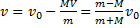 .
To summarize:
.
To summarize:
|
|
|
(16.9) |

Considering
the velocity of the mass relative
to mass :
|
|
|
(16.10) |

This
is the general property of a 1D elastic collision – the relative velocity of
one mass to the other simply reverses the sign due to the collision! [The
corresponding property in any – two is general enough, in effect – dimensions
is that the magnitude of the relative velocity is conserved for an
elastic collision between two objects.] It
is instructive to examine three regimes of the full solution (16.9). (1) If  , then
  and
.
This is, e.g., an elastic ball bouncing off the Earth. The super-massive Earth
doesn’t budge, while the elastic ball will simply reverse the direction (that
is what the negative sign in means),
while keeping its speed. Assuming no air resistance, then, an elastic ball
dropped from a certain height will bounce back to the same height. In real
life, it is impossible to find such a ball, since the real collision is never
truly elastic. (2) If
and
.
This is, e.g., an elastic ball bouncing off the Earth. The super-massive Earth
doesn’t budge, while the elastic ball will simply reverse the direction (that
is what the negative sign in means),
while keeping its speed. Assuming no air resistance, then, an elastic ball
dropped from a certain height will bounce back to the same height. In real
life, it is impossible to find such a ball, since the real collision is never
truly elastic. (2) If  ,
then
,
then  and
and
 .
In this case, the incident mass stops and the target mass moves with the same
velocity as the initial velocity of the incident mass. A real life example
would be a billiard ball (with no spin or “English”) hitting another billiard
ball head-on. (3) If
.
In this case, the incident mass stops and the target mass moves with the same
velocity as the initial velocity of the incident mass. A real life example
would be a billiard ball (with no spin or “English”) hitting another billiard
ball head-on. (3) If  ,
then
,
then  and
and
 .
This is simply the same situation as (1), but with the roles of and reversed. So, let us express all
velocities in the reference frame of in
the initial state (before collision). Mathematically, this means subtracting from
all velocities. In this frame, is
at rest, moves
at
.
This is simply the same situation as (1), but with the roles of and reversed. So, let us express all
velocities in the reference frame of in
the initial state (before collision). Mathematically, this means subtracting from
all velocities. In this frame, is
at rest, moves
at  is
at rest and, moves
at .
is
at rest and, moves
at .
 Example 16.2 Two identical masses do a
head-on elastic collision with the velocities and
Example 16.2 Two identical masses do a
head-on elastic collision with the velocities and
 .
What are the velocities in the final state?
.
What are the velocities in the final state?
Solution. Example
16.1 provided an effectively complete and general solution for a 1D elastic
collision. How come? Wasn’t the initial condition a special one ( at rest) rather than a general
one? Well, despite this, the fact that any reference frame which is not
accelerating relative to an inertial frame is another inertial reference frame
makes the solution of Example 16.1 an effectively complete solution. Here
is what we mean: if mass is
moving initially, then re-frame the question using the rest frame of mass , use the result of the previous
example, and then covert the velocity values back to those of the original
reference frame. Here it goes for this particular example. First, use the
reference frame in which the second mass is at rest. This means subtracting ,
i.e. adding .
In this new reference frame, the first mass is moving at  ,
while the second mass is, of course, at rest. Second, by using the result of
the previous Example (limit (2)), we know then that, in the final state, the
first mass is at rest and the second mass moves at .
Third, come back to the original reference frame, by subtracting .
So, answer =
,
while the second mass is, of course, at rest. Second, by using the result of
the previous Example (limit (2)), we know then that, in the final state, the
first mass is at rest and the second mass moves at .
Third, come back to the original reference frame, by subtracting .
So, answer =  and
,
i.e. each velocity is simply reversed.
and
,
i.e. each velocity is simply reversed.
Example 16.3 Totally inelastic collision
(Ex. 9.10 of textbook). Ballistic pendulum. If block+bullet goes up by
 ,
what was ?
Block mass = ,
bullet mass = .
Initial velocity of bullet = .
,
what was ?
Block mass = ,
bullet mass = .
Initial velocity of bullet = .
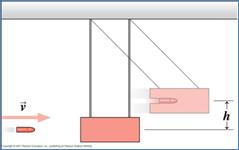 Solution.
This is the case
of a total inelastic collision, since the two (block and bullet) become one in
the final state. Also, one should keep in mind that the initial state and the
final state of the collision both occur during a short time interval when the bullet
hits the block, while the height remains practically unchanged. So, for the
collision, the momentum conservation equation
Solution.
This is the case
of a total inelastic collision, since the two (block and bullet) become one in
the final state. Also, one should keep in mind that the initial state and the
final state of the collision both occur during a short time interval when the bullet
hits the block, while the height remains practically unchanged. So, for the
collision, the momentum conservation equation  is
the only equation to use. After the collision, the pendulum swings up, and the
total energy is conserved.
is
the only equation to use. After the collision, the pendulum swings up, and the
total energy is conserved.  ,
i.e.
,
i.e.  .
Plugging this into the momentum conservation equation, we get
.
Plugging this into the momentum conservation equation, we get  .
A way to measure the speed of the bullet.
.
A way to measure the speed of the bullet.
 Example
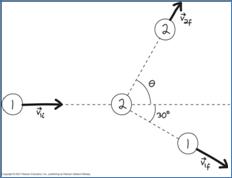
16.4 Elastic
collision in two dimensions (Ex. 9.12 of textbook). A ball strikes a stationary
ball of the same mass, and comes out at 30 degrees. In what direction is the
other ball moving?
Example
16.4 Elastic
collision in two dimensions (Ex. 9.12 of textbook). A ball strikes a stationary
ball of the same mass, and comes out at 30 degrees. In what direction is the
other ball moving?
Solution. The
answer is 60 degrees, since it is well-known that, for a 2D collision of
identical masses with one mass at rest, the two masses move at 90 degrees with
respect to each other in the final state. A good pool player knows and makes
use of this fact! Let us see how this can be derived mathematically. First,
the momentum conservation  .
Second, the energy conservation
.
Second, the energy conservation  .
By virtue of all masses being equal, these equations become simple: (1)
.
By virtue of all masses being equal, these equations become simple: (1)  (1)
and (2)
(1)
and (2)  .
(1) means
.
(1) means  ,
which leads to
,
which leads to  .
Comparing this with (2), we conclude that
.
Comparing this with (2), we conclude that  ,
i.e.
,
i.e.  and
and
 are
perpendicular/orthogonal to each other.
are
perpendicular/orthogonal to each other.
Elastic collision in two dimensions
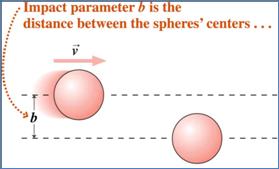 An
elastic collision between two particles in two dimensions is not as easy to
solve as an elastic collision in one dimension (Example 16.1). The reason is
that in the final state, there are four unknowns (two velocities, each velocity
having two components), while the momentum conservation (a vector equation – so
there are two equations) and the energy conservation (a scalar equation – so
this is one equation) give only three equations. Four unknowns require four
equations, not three equations, for a complete solution. What is the missing
information? The angular momentum! Consider a ball coming and hitting
another ball at rest in the above diagram. The vertical distance between the
two balls is called the impact parameter,
An
elastic collision between two particles in two dimensions is not as easy to
solve as an elastic collision in one dimension (Example 16.1). The reason is
that in the final state, there are four unknowns (two velocities, each velocity
having two components), while the momentum conservation (a vector equation – so
there are two equations) and the energy conservation (a scalar equation – so
this is one equation) give only three equations. Four unknowns require four
equations, not three equations, for a complete solution. What is the missing
information? The angular momentum! Consider a ball coming and hitting
another ball at rest in the above diagram. The vertical distance between the
two balls is called the impact parameter,  . Notice that the angular
momentum of the incident ball relative to the ball at rest is given by
. Notice that the angular
momentum of the incident ball relative to the ball at rest is given by  [the easiest way
to see this is to break down – “resolve” – the position vector of the incident
ball to the component parallel to
[the easiest way
to see this is to break down – “resolve” – the position vector of the incident
ball to the component parallel to  and the component
perpendicular to ; only the 2nd
component gives rise to
and the component
perpendicular to ; only the 2nd
component gives rise to  ]
which is the total angular momentum conserved in this collision. With
the addition of impact parameter, the elastic collision in two dimensions
becomes completely solvable. For instance, the impact parameter is what
determines what angle the incident ball will be deflected – 30 degrees in the last
example.
]
which is the total angular momentum conserved in this collision. With
the addition of impact parameter, the elastic collision in two dimensions
becomes completely solvable. For instance, the impact parameter is what
determines what angle the incident ball will be deflected – 30 degrees in the last
example.