Lecture 14
Rotational Motion (continued)
Center of mass
The center of mass of an object is defined as
|
|
|
(14.1) |
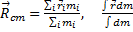
 In words, this definition means that the position of
the center of mass of an object is defined as the mass-weighted average of
position vectors of all parts of the object. The object may be viewed as
consisting of discrete parts (the first definition), or continuous parts (the
2nd definition), but really these two definitions should be viewed as
equivalent, since an integration is essentially a summation.
In words, this definition means that the position of
the center of mass of an object is defined as the mass-weighted average of
position vectors of all parts of the object. The object may be viewed as
consisting of discrete parts (the first definition), or continuous parts (the
2nd definition), but really these two definitions should be viewed as
equivalent, since an integration is essentially a summation.
Note
that in the above definitions, the denominator ( or
or
 )
is the total mass, which we will denote as
)
is the total mass, which we will denote as  .
.
Parallel axis theorem [optional]
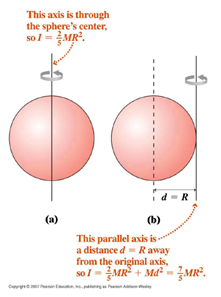
The parallel axis theorem is a very well-known theorem about the rotational inertia.
|
|
|
(14.2) |

Here,
 is
the rotational axis around a certain axis (call it axis 1) that does not pass
through the center of mass. Then, there must be an axis (call it axis 2) that
passes through the center of mass and is parallel to axis 1.
is
the rotational axis around a certain axis (call it axis 1) that does not pass
through the center of mass. Then, there must be an axis (call it axis 2) that
passes through the center of mass and is parallel to axis 1.  is
the rotational inertia around axis 2, and
is
the rotational inertia around axis 2, and  is the distance between axis 1
and axis 2.
is the distance between axis 1
and axis 2.
 Angular velocity, revisited
Note
that we defined angular velocity  as
"merely"
as
"merely"  thus
far. This is OK, but not enough. Why not enough? Consider the case of a
uniform circular motion. In this case, the angular velocity is constant. What is its
direction? It better be constant as well. How do we define its direction?
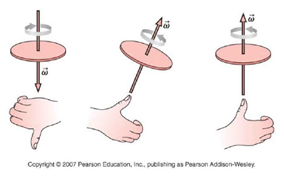
The answer is the right hand rule (see the picture). This is a mere
definition, or a convention if you like. Note that the torque vector in terms
of position vector and force vector was defined also using the right hand
rule. This is no coincidence. With the direction clearly defined like this,
we can upgrade our notation of to
include the arrow symbols as in
thus
far. This is OK, but not enough. Why not enough? Consider the case of a
uniform circular motion. In this case, the angular velocity is constant. What is its
direction? It better be constant as well. How do we define its direction?
The answer is the right hand rule (see the picture). This is a mere
definition, or a convention if you like. Note that the torque vector in terms
of position vector and force vector was defined also using the right hand
rule. This is no coincidence. With the direction clearly defined like this,
we can upgrade our notation of to
include the arrow symbols as in  .
.
Recall
that we defined a positive angular velocity for a counter clock wise motion and
a negative angular velocity for a clock wise motion. What does it really
mean? It means the following. As an example, suppose that an object is
rotating CCW at an angular speed of 3 Hz in the x-y plane. Then its angular
velocity  Hz.
If it is rotating CW at an angular speed of 3 Hz in the x-y plane, then its
angular velocity
Hz.
If it is rotating CW at an angular speed of 3 Hz in the x-y plane, then its
angular velocity  Hz.
Please convince yourself of this by drawing x-y-z axes, and considering the
right hand rule.
Hz.
Please convince yourself of this by drawing x-y-z axes, and considering the
right hand rule.
Angular acceleration, revisited
How about the angular
acceleration  ?
It is simple. Now that we completely defined the vector ,
we can simply upgrade this definition of the angular acceleration to
?
It is simple. Now that we completely defined the vector ,
we can simply upgrade this definition of the angular acceleration to
|
|
|
(14.3) |

So, if
the angular speed (that is,  )
is increasing, then
)
is increasing, then  points
parallel to ,
i.e. points to the same direction as .
If the angular speed is decreasing, then points
anti-parallel to ,
i.e. points opposite to the direction of .
points
parallel to ,
i.e. points to the same direction as .
If the angular speed is decreasing, then points
anti-parallel to ,
i.e. points opposite to the direction of .
Newton's 2nd law for rotational motion
We already know Newton's 2nd law, and we definitely do not have a new law just because we are considering rotational motions. However, it can be shown (in advanced mechanics) that Newton's 2nd law can be re-written in the following form that is more convenient for a rotational motion.
|
|
|
(14.4) |

This
equation is valid not only for an inertial reference frame but also for a
center of mass reference frame.
Here,  is
the net torque, i.e. the sum of all torques due to external
forces. [Actually,
is
the net torque, i.e. the sum of all torques due to external
forces. [Actually,  is the net torque only
if all torques due to internal forces cancel each other. This is the case as
far as all the materials of this course are concerned, and is a very common
case in general anyway. In general, this is the case when internal forces
satisfy what is called the "strong form of Newton's 3rd law": not
only the two Newton's 3rd law pair forces are equal in magnitude and opposite
in direction, but their directions are either parallel or anti-parallel to
is the net torque only
if all torques due to internal forces cancel each other. This is the case as
far as all the materials of this course are concerned, and is a very common
case in general anyway. In general, this is the case when internal forces
satisfy what is called the "strong form of Newton's 3rd law": not
only the two Newton's 3rd law pair forces are equal in magnitude and opposite
in direction, but their directions are either parallel or anti-parallel to  , where
  ,
, are position vectors
of the two particles exchanging 3rd law pair forces.]
are position vectors
of the two particles exchanging 3rd law pair forces.]
 is
the angular momentum. We will define the angular momentum shortly, but
here is one thing to keep in mind.
is
the angular momentum. We will define the angular momentum shortly, but
here is one thing to keep in mind.
Note that a center of mass reference frame is not an inertial reference frame in general. Think of a figure skater doing a jump or an Olympic diver doing a jump off the board. In both examples, the center of mass is accelerated by the gravitational force and possibly other forces such as air resistance. Thus, the center of mass frame is an accelerated frame. However, by the special nature of the center of mass, the above equation is valid in the center of mass reference frame! [The proof of this fact involves a bit of not-so-complicated vector algebra, and is not usually given at this level. You are welcome to ask me, if you so desire.]
Angular momentum
In general, the angular momentum of a very small particle ("point particle") is defined as
|
|
|
(14.5) |

 Example
1. For a
uniform circular motion, show that the angular momentum is constant.
Example
1. For a
uniform circular motion, show that the angular momentum is constant.
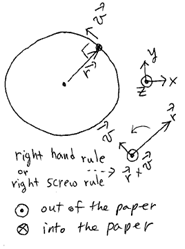
Solution. Consider the CCW motion as
depicted in the figure. By the right hand rule (right screw rule may be a
better name), points
along the  direction. This is true for any position
on the circle, not just the one example position shown in the figure. The magnitude
of is
given by
direction. This is true for any position
on the circle, not just the one example position shown in the figure. The magnitude
of is
given by  ,
where
,
where  and
and
 are
the magnitudes of
are
the magnitudes of  and
and
 respectively.
is
constant (circular motion), and is
constant (uniform circular motion). In conclusion, the magnitude of is
constant, as well as its direction, and so is
constant. If the motion is CW, then only the direction of is
flipped, but the magnitude and the time-independence of remain
unchanged.
respectively.
is
constant (circular motion), and is
constant (uniform circular motion). In conclusion, the magnitude of is
constant, as well as its direction, and so is
constant. If the motion is CW, then only the direction of is
flipped, but the magnitude and the time-independence of remain
unchanged.
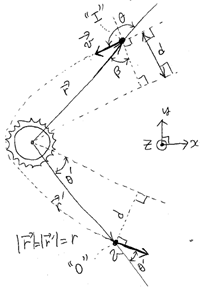 Example
2. A comet of
mass
Example
2. A comet of
mass  is
observed to approach the Sun and go away from the Sun, as depicted in the
figure. The
is
observed to approach the Sun and go away from the Sun, as depicted in the
figure. The  axes
are defined as shown. Consider point "I" (incoming) and point
"O" (outgoing), for which the distance to the Sun is a common value (). It is also observed that the
two points have a common speed, ,
and a common d value (see figure). Show that the angular momentum is
identical for points "I" and "O."
axes
are defined as shown. Consider point "I" (incoming) and point
"O" (outgoing), for which the distance to the Sun is a common value (). It is also observed that the
two points have a common speed, ,
and a common d value (see figure). Show that the angular momentum is
identical for points "I" and "O."
Solution. For
the "I" point, the angular momentum points to the positive direction (the right hand
rule), and its magnitude is  .
For the "O" point, the angular momentum points to the positive
direction also, and its magnitude is
.
For the "O" point, the angular momentum points to the positive
direction also, and its magnitude is  .
QED. [Note that the angular momentum is constant at any point of motion,
actually.]
.
QED. [Note that the angular momentum is constant at any point of motion,
actually.]
Angular momentum of a system of particles
|
|
|
(14.6) |

As always, the continuous case may be viewed also as essentially the discrete case.
Rigid body
A system of many particles whose mutual distances are all constant is called a rigid body.
Namely a rigid body is an object whose shape does not change as a function of time, like a sphere, a cylinder, a dumbbell, etc. Note that whether an object is a rigid body or not may also depend on the motion that we consider. Suppose there is a figure skater, who is (a) turning round and round with arms and legs stretched, and then after a while (b) turning round and round with arms and legs pulled in. If we consider (a) and (b), and transitional motions between them, together, the person is definitely not a rigid body. However, if we consider (a) or (b) alone, we may consider the person as a rigid body, since the shape of the body does not change during the motion (a) or (b).
For a rigid body [rotating around a "highly symmetric axis", for the first two], the following equations apply.
|
|
|
(14.7) |
|
|
|
(14.8) |
|
|
|
(14.9) |


In
general, one should be cautious of the fact that  (and
thus
(and
thus  )
may not be true. An example would be an apple rotating around an oddly
oriented axis, if we take into account the shape of the apple in all details,
not approximating it as a simple sphere. In such a case, one can show that and
are
not parallel to each other! But, don't worry. In this course, we won't
consider such difficult cases, when we do quantitative problems. So,
you can assume that the above equations to be valid for any rigid bodies for
the purpose of this course. Nevertheless, you should keep in mind that Eqs. (14.4), (14.5), and (14.6) are the more fundamental ones.
)
may not be true. An example would be an apple rotating around an oddly
oriented axis, if we take into account the shape of the apple in all details,
not approximating it as a simple sphere. In such a case, one can show that and
are
not parallel to each other! But, don't worry. In this course, we won't
consider such difficult cases, when we do quantitative problems. So,
you can assume that the above equations to be valid for any rigid bodies for
the purpose of this course. Nevertheless, you should keep in mind that Eqs. (14.4), (14.5), and (14.6) are the more fundamental ones.
Note
that the expression for  (Eq.
(14.9)) is a general one, and is valid
even if the rotation axis is not a "highly symmetric axis."
(Eq.
(14.9)) is a general one, and is valid
even if the rotation axis is not a "highly symmetric axis."
Total kinetic energy for a rigid body
Assume
that a rigid body is moving as a whole, while it is also rotating around its
center of mass. Let the total mass of the rigid body be and the velocity of the center
of mass be  .
Assume that the moment of inertia (just another name for the rotational
inertia) around the center of mass is and
the angular velocity is .
Then the total kinetic energy is given by
.
Assume that the moment of inertia (just another name for the rotational
inertia) around the center of mass is and
the angular velocity is .
Then the total kinetic energy is given by
|
|
|
(14.10) |

Keep in mind the importance of the center of mass point in this formula.
Example
3. Suppose an
object with the total mass and the radius  has the rotational inertia
  .
For example,
.
For example,  (thin
ring or a hollow cylinder), 2/5 (solid sphere), 1/2 (disk or solid cylinder)
2/3 (hollow sphere) are possible values (see Table 10.2 of text, copied in LN
13). Suppose the object is rolling on a surface without slipping. What is
the total kinetic energy in terms of
(thin
ring or a hollow cylinder), 2/5 (solid sphere), 1/2 (disk or solid cylinder)
2/3 (hollow sphere) are possible values (see Table 10.2 of text, copied in LN
13). Suppose the object is rolling on a surface without slipping. What is
the total kinetic energy in terms of  ,
and
,
and  ?
?
Solution: For
a rolling motion without slipping, we learned that  (LN
09, page 9; your note should show more details, which I gave in lecture).
Thus, the rotational kinetic energy is given by
(LN
09, page 9; your note should show more details, which I gave in lecture).
Thus, the rotational kinetic energy is given by  .
Thus, the total kinetic energy =
.
Thus, the total kinetic energy =  .
.
Example 4. A solid sphere and a hollow sphere are released from rest on an incline from the same height. They roll down. Which one arrives at the bottom of the incline first?
Solution:
Solid sphere. Why? Because is smaller for it than the
hollow sphere. Here are the details. Using energy conservation and the result
of the previous example, we get 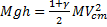 ,
and so
,
and so  ,
where
,
where  is
the initial height. This means a larger value of
is
the initial height. This means a larger value of  for
a smaller value of .
Also, note that does
not depend on the mass at all. So, the average speed of the solid sphere must
be greater, which means less time for the solid sphere.
for
a smaller value of .
Also, note that does
not depend on the mass at all. So, the average speed of the solid sphere must
be greater, which means less time for the solid sphere.
"Translation table" (for quick reference only; know physics)
|
General or linear motions (inertial frame) |
Rotational motion (inertial frame or center of mass frame) |
|
|
|
|
|
|
|
|
|
|
Linear motion in one dimension |
Rotational
motion of a rigid body (for |
|
|
|
|
|
|
|
|
|
|
|
|
|
|
|
|
|
|
|
|
|
|
|
|


Angular momentum conservation
When the
net torque is zero, then the angular momentum is conserved. This follows from  .
.
Linear momentum conservation (obviously not for rotational motion!; included for comparison with the angular momentum conservation)
When the
net force is zero, then the linear momentum is conserved. This follows from  .
.
Although
these two extremely important conservation principles are easy to state, one
should keep in mind that these conservation principles apply even when the
object under consideration consists of many parts and is not a rigid
body. The above Examples 1 and 2 are simple cases of the conservation
at work. Examples 11.2 and 11.3 of textbook are also very important to
understand for the angular momentum conservation principle! We will consider
the linear momentum conservation in later lectures.