Lecture 11
Power, Kinetic Energy, and the Work-Energy theorem
Power
An
adult is generally a better worker than a child. For example, for a given time
an adult usually can do more work than a child. Thus how much work can be done
per unit time is an important concept, and this is the concept of power. In
previous lectures, we introduced the notations  and
and
 ,
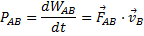
to mean force by A on B or work by A on B. The (instantaneous) power
supplied/given by A to B is defined as
,
to mean force by A on B or work by A on B. The (instantaneous) power
supplied/given by A to B is defined as
|
|
|
(11.1) |
Note
that 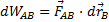 (this
is from (10.1), with explicit A,B subscripts) and thus we get
(this
is from (10.1), with explicit A,B subscripts) and thus we get  ,
which is the derivation of the 2nd part of this equation. The average
power is given by
,
which is the derivation of the 2nd part of this equation. The average
power is given by
|
|
|
(11.2) |

The SI unit of power is W(att) = J(oule)/s(econd).
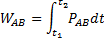
Since the power is the derivative of work, the inverse relation is
|
|
|
(11.3) |
Kinetic energy
Here
we introduce, for the first time, the very important concept: “energy.”
One form of energy is the kinetic energy. Consider the net force  acting on object B, and consider
the power put into the object B by the net force (i.e.
the power put into object B by all objects exerting force on B):
acting on object B, and consider
the power put into the object B by the net force (i.e.
the power put into object B by all objects exerting force on B):  .
By Newton’s 2nd law (we consider constant mass),
.
By Newton’s 2nd law (we consider constant mass),  ,
and thus,
,
and thus,  .
At this point, note that
.
At this point, note that  ,
where the chain rule of the differential calculus and
,
where the chain rule of the differential calculus and  is
used. Thus, we get
is
used. Thus, we get  .
Plugging this result into the equation for
.
Plugging this result into the equation for  ,
we get
,
we get  .
The quantity
.
The quantity  is
called the kinetic energy of B. In general,
is
called the kinetic energy of B. In general,
|
|
|
(11.4) |

Note
that  is
the speed, i.e. the magnitude of the velocity, in this expression. In terms of
this kinetic energy function, what we just proved is extraordinary:
is
the speed, i.e. the magnitude of the velocity, in this expression. In terms of
this kinetic energy function, what we just proved is extraordinary:  .
Using this on
.
Using this on
(11.3), we can see that the work done
by the net force on B,  ,
is given as
,
is given as  .
This is the celebrated work-energy theorem. What it says is that the total
work received by an object shows up as the change in its kinetic energy.
.
This is the celebrated work-energy theorem. What it says is that the total
work received by an object shows up as the change in its kinetic energy.
Work-Energy theorem
|
|
|
(11.5) |

The net work received by an object, i.e. the work done by the net force on the object, is equal to the change of its kinetic energy.
The importance and the generality of this theorem cannot be over-emphasized. It is valid for any type of motion and any type of forces. In a way, this theorem is more general than the more famous “conservation of the mechanical energy,” which we will learn shortly. Why? As we will see later, the energy conservation theorem holds only for “nice” forces, i.e. when all forces are “conservative” forces (to be defined later). On the other hand, the work-energy theorem is always applicable [in 6A], having no such restriction! You should always remember this important point!
By the work-energy theorem, it follows that the dimension of energy is the dimension of work. Thus, the unit of energy is also J(oule). In everyday situations, kW h (kilo-watt-hour) is also an often used unit of energy [1 kW h = 3.6 million J]. Next time you look at your PG&E bill, look for that unit – I guarantee you can find it.
Example
1. Consider our
familiar example of tossing a ball, with the initial velocity  (taking
“up” to be “positive”) and the height
(taking
“up” to be “positive”) and the height  . Ignore air resistance. We
consider the symmetric motion of the ball going up and then coming down to the
initial position. What is the net work done on the ball (i) on the way up,
(ii) on the way down, and (iii) for the total motion?
. Ignore air resistance. We
consider the symmetric motion of the ball going up and then coming down to the
initial position. What is the net work done on the ball (i) on the way up,
(ii) on the way down, and (iii) for the total motion?
Solution: (i) On the way up, the final
kinetic energy is 0, and so the net work is  .
(ii) On the way down,
.
(ii) On the way down,  ,
and this is the net work done on the ball. (iii) For the total motion, the
kinetic energy did not change, and thus the net work done is 0. Note that in
this example the only force acting on the ball is the gravity, and the work
done by it is negative for (i) and positive for (ii), and so our answers make
sense in terms of the sign. In fact, there is more. We know that the work
done by gravity is given by
,
and this is the net work done on the ball. (iii) For the total motion, the
kinetic energy did not change, and thus the net work done is 0. Note that in
this example the only force acting on the ball is the gravity, and the work
done by it is negative for (i) and positive for (ii), and so our answers make
sense in terms of the sign. In fact, there is more. We know that the work
done by gravity is given by  (Example
2 of LN 10). So, for part (i) we have
(Example
2 of LN 10). So, for part (i) we have 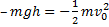 and
for (ii) we have
and
for (ii) we have 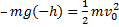 .
This means
.
This means  ,
which is what we already know. The “magic” here is that we could find this out
without using any equations for
,
which is what we already know. The “magic” here is that we could find this out
without using any equations for  and
and
 .
This is often the case – when you are not asked about time or velocity
components, the work-energy theorem (or the mechanical energy conservation) is generally
a more powerful and quicker way to get the answer.
.
This is often the case – when you are not asked about time or velocity
components, the work-energy theorem (or the mechanical energy conservation) is generally
a more powerful and quicker way to get the answer.
Example
2. For a one
dimensional constant acceleration problem, show that the equation  follows
directly from the work-energy theorem.
follows
directly from the work-energy theorem.
Solution: The constant acceleration
means that the net force is constant also, due to  (assuming constant
  of course). In this case the
net work is simply
of course). In this case the
net work is simply  ,
from (10.4). By the work energy theorem,
,
from (10.4). By the work energy theorem,  .
On the other hand,
.
On the other hand,  .
From these two equations, we get
.
From these two equations, we get  .
.
Examples 6.6, 6.7 (basic), 6.8 (basic), and 6.9 of the textbook must be mastered.