Lecture 10
Work
Work, infinitesimal
Suppose
that a force  (which
may or may not be a net force) is acting on an object. We consider an infinitesimal time
interval,
(which
may or may not be a net force) is acting on an object. We consider an infinitesimal time
interval,  ,
during which the position changes by the displacement,
,
during which the position changes by the displacement,  .
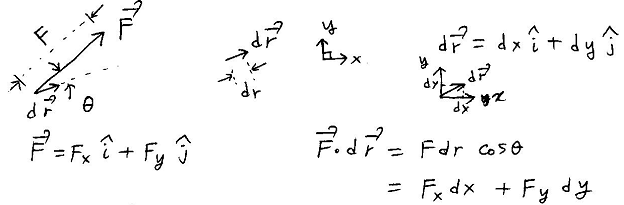
The infinitesimal work,
.
The infinitesimal work,  ,
done by the force on the object is defined as
,
done by the force on the object is defined as
|
|
|
(10.1) |

In mathematics, “infinitesimal” means something like “smaller than any number that you can think of.” In physics, it simply means “very small compared to the scale of the problem or the measurement error.” One thing to remember is that as far as these infinitesimal quantities are concerned, any motion is a motion on an approximately straight line (“tangent”). This is because, as I discussed in the mini-review of calculus a while ago, any curve is a line when looked at in very small length scales.
Note that
we are using the scalar product here. If not familiar with it, you need to go
back to LN 04. If the angle between and
is
 ,
,
 and
and
 ,
,
|
|
|
(10.2) |

Work, finite
Suppose
a force (which
may or may not be a net force) is acting on an object, which moves from
position  to
to
 .
The work done by the
force on the object is then given by
.
The work done by the
force on the object is then given by
|
|
|
(10.3) |

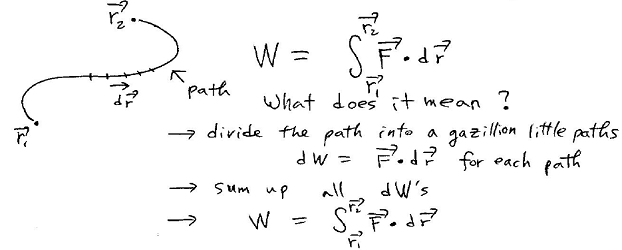 The
integral expression is called a “line integral”. You need not be scared by it,
even if you did not learn about it. It is the sum over all infinitesimal ’s corresponding to a “gazillion”
little paths that make up the entire path when summed up. [Note:
we use subscript1 (as in
The
integral expression is called a “line integral”. You need not be scared by it,
even if you did not learn about it. It is the sum over all infinitesimal ’s corresponding to a “gazillion”
little paths that make up the entire path when summed up. [Note:
we use subscript1 (as in  ) and subscript 2 (as
in
) and subscript 2 (as
in  ) to mean two points of
interest in a motion.]
) to mean two points of
interest in a motion.]
Note that in general  changes
as a function of position so it cannot be taken out of the integral symbol. If it is known to be a
constant value, then it can. In that case,
changes
as a function of position so it cannot be taken out of the integral symbol. If it is known to be a
constant value, then it can. In that case,
|
|
|
(10.4) |

Note
in all of this that we talk about the work done by a force, not necessarily the
net force, when an object is moving from one place to the next. The motion of
an object is always the result of the net force by Newton’s 2nd
law. For that motion, we can talk about the work done by various forces. Some
may have done positive work, and some may have done negative work, and some may
have done no work! This all depends on the angle between the force and the
displacement! Just as  and
and
 are
“apple and orange,” so
are and
are
“apple and orange,” so
are and
 (or
(or
 )!
)!
The SI unit of work = Joule
J(oule)
is the SI unit of work, in other words, J = N m (i.e. newton-meter) = kg  .
As we will see later, the unit of work is the same as the unit of energy (as is
the unit of heat). 4.2 Joules is 1 calorie.
.
As we will see later, the unit of work is the same as the unit of energy (as is
the unit of heat). 4.2 Joules is 1 calorie.
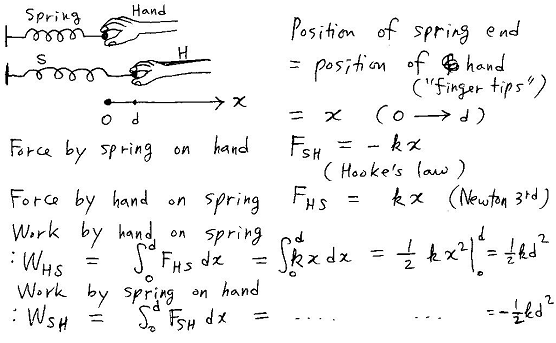
Example 1: A spring is attached to a wall. The spring constant k = 100 N /m. You grab the other end, and you stretch the spring very very slowly (“adiabatically”). You stretch it by 1 cm = 0.01 m. How much work did you do to the spring? How much work did the spring do to you?
Solution:  (work
done by hand on spring) =
0.005 J.
(work
done by hand on spring) =
0.005 J.  =
–0.005 J. See the figure for explanation. Why is the work done by spring on
hand negative? Because the spring was exerting the force in the opposite
direction to the movement. In contrast,
=
–0.005 J. See the figure for explanation. Why is the work done by spring on
hand negative? Because the spring was exerting the force in the opposite
direction to the movement. In contrast,  did
a positive work, since its direction was parallel to the direction of the
motion. [Note that in this example
did
a positive work, since its direction was parallel to the direction of the
motion. [Note that in this example  is
the position coordinate of an object (end of spring), since the other end of
the spring is fixed (cf. LN 08).]
is
the position coordinate of an object (end of spring), since the other end of
the spring is fixed (cf. LN 08).]
Example 2: Sisyphus is rolling a boulder from the bottom of the hill to the top of the hill, as shown. What is the work that the Earth(’s gravity) did on the boulder?

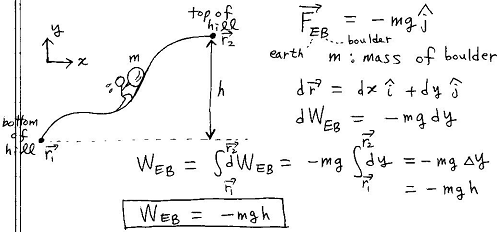 Solution:
As shown in the figure, the work by the Earth on the boulder is
Solution:
As shown in the figure, the work by the Earth on the boulder is  where
where  is the mass of the boulder, and
  is the height of the hill. Note
that this solution does not depend on the shape of the hill at all! Also,
note that the Earth did a negative work on the boulder. [Poor
Sisyphus of course must have done a positive work on the boulder, because he
pushed the ball up, i.e. he pushed the ball in the same direction as the direction
of the movement. If the ball moved very very slowly (in other words
“adiabatically”), then at every moment the acceleration of the ball can be
ignored (
is the height of the hill. Note
that this solution does not depend on the shape of the hill at all! Also,
note that the Earth did a negative work on the boulder. [Poor
Sisyphus of course must have done a positive work on the boulder, because he
pushed the ball up, i.e. he pushed the ball in the same direction as the direction
of the movement. If the ball moved very very slowly (in other words
“adiabatically”), then at every moment the acceleration of the ball can be
ignored ( = 0), and so one can
show that the work done by Sisyphus is exactly
= 0), and so one can
show that the work done by Sisyphus is exactly  .
This is called the work done against the gravity. The easiest way to derive
this is by using the “work-energy theorem” (next lecture), but you can also
show this using the free body diagram of the boulder. I challenge you to do
the latter!]
.
This is called the work done against the gravity. The easiest way to derive
this is by using the “work-energy theorem” (next lecture), but you can also
show this using the free body diagram of the boulder. I challenge you to do
the latter!]
Examples 6.1 (basic), 6.2, 6.3, 6.4 of the textbook must be mastered.