Lecture 8
Spring Force and Newton’s 3rd law
Spring force, Hooke’s law, apparent weight, normal force, frictional force
Hooke’s law (spring force)
By
experience we know that a spring is resilient. If we push it, then it pushes
us back. If we pull it, then it pulls us back. So, a spring exerts a force on
the object that is attached to it, in a way to restore its shape. This force
is the spring force. It is a “restoring force,” just as the tension force is.
Assume that a spring has a certain natural length, and it has been compressed
or elongated by the distance  . Then, Hooke’s law says (for
small ):
. Then, Hooke’s law says (for
small ):
|
|
|
(8.1) |

 Here,
Here,  is the spring constant, a fixed
inherent value for a given spring.
is the spring constant, a fixed
inherent value for a given spring.
Equation
(8.1) is a somewhat unique equation,
to be interpreted carefully. In this equation, is  a position coordinate for any
object! Instead should
be considered as always positive. The fact that
a position coordinate for any
object! Instead should
be considered as always positive. The fact that  is
negative does mean
that it points to a certain direction! It just means that force is in the
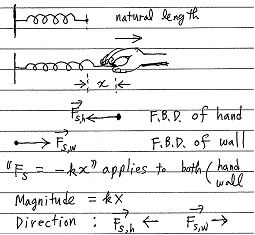
direction to restore the spring’s natural length, i.e., to “undo .” A spring exerts forces on the two ends of it, and
for both of them this equation is applicable. However the two spring forces
are exactly opposite in direction, as illustrated in the figure. [Note:
The two free body diagrams in the figure are not complete, in that they
show only the forces due to the spring.]
is
negative does mean
that it points to a certain direction! It just means that force is in the
direction to restore the spring’s natural length, i.e., to “undo .” A spring exerts forces on the two ends of it, and
for both of them this equation is applicable. However the two spring forces
are exactly opposite in direction, as illustrated in the figure. [Note:
The two free body diagrams in the figure are not complete, in that they
show only the forces due to the spring.]
Example 1. [Spring force, and apparent weightlessness] Suppose that you are standing on a spring which is placed on the floor of an elevator. How much the spring gets depressed due to you being on top of it gives a measure of how heavy you are. This is [a simplified view of] how a real scale works. What is measured by such a scale is not the weight (which is the gravitational force, as defined in Example 1), but is defined as the “apparent weight.” Suppose that the elevator was severed from the cable by a powerful super villain, who throws the elevator away. We consider the motion of the elevator with you and the spring scale inside it, after the elevator leaves the villain’s hands. Consider the following cases: (1) the elevator is falling down vertically, (2) the elevator is moving up vertically, and (3) the elevator is making a parabolic trajectory. In all these cases, assume no air-resistance (free fall). What should be your apparent weight in each case?
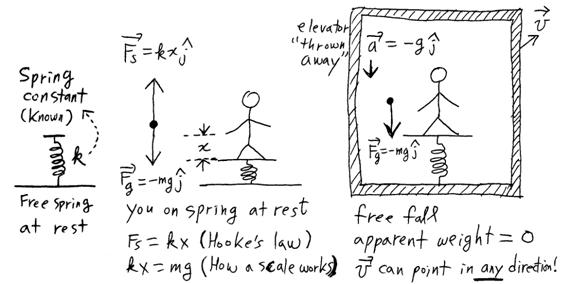 Solution: Look at the diagram on the
right. What is the acceleration of the elevator? Since there is no other
object attached to the elevator, once it leaves the hand of the super villain, the
only force acting on it is the gravitational force. Thus, the acceleration is
g (9.8 in the SI unit), downward. You in the elevator are also moving with the
same acceleration. Say, you stand on the spring scale to measure your apparent
weight. There are two forces that act on you, the weight (
Solution: Look at the diagram on the
right. What is the acceleration of the elevator? Since there is no other
object attached to the elevator, once it leaves the hand of the super villain, the
only force acting on it is the gravitational force. Thus, the acceleration is
g (9.8 in the SI unit), downward. You in the elevator are also moving with the
same acceleration. Say, you stand on the spring scale to measure your apparent
weight. There are two forces that act on you, the weight ( )
and possibly the spring force (
)
and possibly the spring force ( ).
The net force is
).
The net force is  ,
which should be equal to
,
which should be equal to  .
But, wait, is
already ,
so there should not be any spring force:
.
But, wait, is
already ,
so there should not be any spring force:  .
Thus, in all cases (1),(2),(3), your apparent weight is zero! This is what we
call “weightlessness” in everyday language, since you “feel weightless.” In
physics, this is only an apparent weightlessness, as the weight
is defined as mass times the gravitational acceleration (LN 7, Example 1).
[Question: if you are in a space shuttle orbiting the earth, will you also feel
the apparent weightlessness?]
.
Thus, in all cases (1),(2),(3), your apparent weight is zero! This is what we
call “weightlessness” in everyday language, since you “feel weightless.” In
physics, this is only an apparent weightlessness, as the weight
is defined as mass times the gravitational acceleration (LN 7, Example 1).
[Question: if you are in a space shuttle orbiting the earth, will you also feel
the apparent weightlessness?]
Example 4.5 of the textbook should be easy to do, and should be mastered.
Newton’s third law
“When
there is an action, there is a reaction” is a quick way that Newton’s 3rd
law is stated. More precisely, it means the following, whenever an object A
exerts a force  on
an object B, the object B exerts an opposite force
on
an object B, the object B exerts an opposite force  on
the object A. Moreover,
the two forces,
on
the object A. Moreover,
the two forces,  and
and
 ,
called Newton’s 3rd law pair forces, are of the same kind. We “kind of know” this principle
by experience. For instance, let us consider the “hand pulling a spring”
situation. As we discussed, if you pull (or push) the spring by then the spring pulls (pushs)
you back by
,
called Newton’s 3rd law pair forces, are of the same kind. We “kind of know” this principle
by experience. For instance, let us consider the “hand pulling a spring”
situation. As we discussed, if you pull (or push) the spring by then the spring pulls (pushs)
you back by  .
How much are you pulling the spring? The answer is given by Newton’s 3rd
law: by ,
in the opposite direction. Newton’s 3rd law is much more general
than Newton’s 1st and 2nd laws, as it is proven to be
true in any situation, not just those situations described by Newton’s 2nd
law (which breaks down at high speed values and very small or very large length
scales). What does it mean that the 3rd law pair forces are of the
same kind? It means that they should be both contact forces, if one is. Or,
they should be both gravitational forces, if one is. So, it is very
important to realize that the 3rd law pair forces, if they are
contact forces, occur right at the same contact!
.
How much are you pulling the spring? The answer is given by Newton’s 3rd
law: by ,
in the opposite direction. Newton’s 3rd law is much more general
than Newton’s 1st and 2nd laws, as it is proven to be
true in any situation, not just those situations described by Newton’s 2nd
law (which breaks down at high speed values and very small or very large length
scales). What does it mean that the 3rd law pair forces are of the
same kind? It means that they should be both contact forces, if one is. Or,
they should be both gravitational forces, if one is. So, it is very
important to realize that the 3rd law pair forces, if they are
contact forces, occur right at the same contact!
Example 2. [Normal force] You are standing still on the Earth. Show that at the contact point, there must be a Newton’s 3rd law pair forces between you and the earth. What are their magnitudes and directions?
Solution: Consider a free body diagram of you. You know that there is the weight force acting on you. This can’t be the only force since then you would have to be accelerating according to Newton’s 2nd law! Since you are standing still, and since you are in contact with the Earth, the Earth must be pushing you with the force that is exactly opposite of your weight! This is the normal force exerted by the Earth on you. This is also a “restoring force”: at the contact, the atoms of the Earth are “fighting” you in order to preserve the shape of the Earth, while your atoms are also “fighting” the Earth in order to preserve your shape. As the name implies, a normal force is normal to the contact surface. So, the earth is applying a normal force on you and you are applying a normal force on earth, and these two forces are exactly equal in magnitude but opposite in direction. In this example, these two normal forces are exactly equal in magnitude to your weight, but this is generally not true (see the next example).
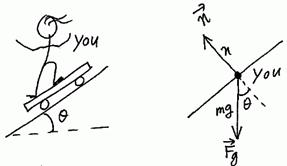 Example
3. [Normal
force on a skateboarder] You are riding a skateboard on a surface with
slope 30 degrees relative to the horizontal surface. Assuming that your mass
is 70 kg, what is the magnitude of the normal force between you and the
skateboard?
Example
3. [Normal
force on a skateboarder] You are riding a skateboard on a surface with
slope 30 degrees relative to the horizontal surface. Assuming that your mass
is 70 kg, what is the magnitude of the normal force between you and the
skateboard?
Solution: From the free body diagram of
you,  since
there is no acceleration (in fact no motion) perpendicular to the surface of
the slope. Thus,
since
there is no acceleration (in fact no motion) perpendicular to the surface of
the slope. Thus,  =
5.9
=
5.9  N.
N.
Example 4. [Frictional force] Suppose that there is a block on a board. The board is connected to a hinge, so that its slope relative to the horizontal surface is adjustable. You are increasing its slope, and at some point the block starts to slide down. Show that there must be a force that acts between the block and the board at the contact surface, parallel to the surface.
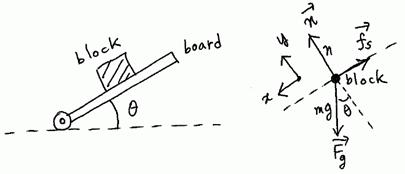 Solution:
Consider the case when the block does not move at all. Then, the net force
should be equal to 0. From the free body diagram of the block, the
Solution:
Consider the case when the block does not move at all. Then, the net force
should be equal to 0. From the free body diagram of the block, the  component of the net force is
  ,
and thus,
,
and thus,  (we
already did this above!). Let us now consider the component of the net force. If
we consider the gravity alone, then it is
(we
already did this above!). Let us now consider the component of the net force. If
we consider the gravity alone, then it is  .
Clearly, this is non-zero when
.
Clearly, this is non-zero when  (and
less than say 90 degrees). So the gravity alone does not satisfy the condition
that the net force is zero! We need to introduce another force that acts in
the opposite direction. This is the frictional force, which should
satisfy, in this problem,
(and
less than say 90 degrees). So the gravity alone does not satisfy the condition
that the net force is zero! We need to introduce another force that acts in
the opposite direction. This is the frictional force, which should
satisfy, in this problem,  .
As we showed, its direction is along the axis, i.e. parallel to the
contact surface.
.
As we showed, its direction is along the axis, i.e. parallel to the
contact surface.
Example 4.4 of text is good, and should be mastered.
Frictional force
We can consider any two surfaces in contact as “temporarily joined.” Thus the contact surface has a degree of resistance to a change. The frictional force can be understood as a “restoring force” when the contact is strained (i.e. deformed) on atomic scales. The empirical laws of friction are
|
|
(8.2) |
|
|
(8.3) |


Here,  =
the magnitude of the static frictional force,
=
the magnitude of the static frictional force,  =
the coefficient of static friction,
=
the coefficient of static friction,  =
the magnitude of the kinetic frictional force,
=
the magnitude of the kinetic frictional force,  =
the coefficient of kinetic friction,
=
the coefficient of kinetic friction,  =
the magnitude of the normal force. The static friction applies when the two
surfaces are at rest with respect to each other. The kinetic friction applies
when one surface is moving with respect to the other surface. In the above
example, when the block is at rest, the static friction applies. As soon as
the block starts to slide down, then the kinetic friction applies, since the
block’s surface and the board’s surface are in relative motion. The frictional
force is a vector, of course, but these equations do not tell the direction.
What is it? In the case of the static friction, it is the opposite to the
applied force parallel to the contact surface. In the case of the the kinetic
friction, it is the opposite of the direction of motion. For instance, if your
hand is pushing a block horizontally on a table, then the block experiences a
frictional force that is in the opposite direction to your push.
=
the magnitude of the normal force. The static friction applies when the two
surfaces are at rest with respect to each other. The kinetic friction applies
when one surface is moving with respect to the other surface. In the above
example, when the block is at rest, the static friction applies. As soon as
the block starts to slide down, then the kinetic friction applies, since the
block’s surface and the board’s surface are in relative motion. The frictional
force is a vector, of course, but these equations do not tell the direction.
What is it? In the case of the static friction, it is the opposite to the
applied force parallel to the contact surface. In the case of the the kinetic
friction, it is the opposite of the direction of motion. For instance, if your
hand is pushing a block horizontally on a table, then the block experiences a
frictional force that is in the opposite direction to your push.
Why is
there a less-than-equal sign in (8.2)? This is because a static
friction is a force that is “turned on” in proportion to the outside force
applied to strain the surface contact. If the outside force is too great, then
the static friction can’t hold the contact bonding any more, and the two
surfaces start to move relative to each other. Right when it starts to move,
the static friction is equal to  .
As soon as it starts to move, though, the friction decreases, since the bonding
between two surfaces in relative motion is necessarily weaker than the bonding
between two surfaces at rest. That is,
.
As soon as it starts to move, though, the friction decreases, since the bonding
between two surfaces in relative motion is necessarily weaker than the bonding
between two surfaces at rest. That is,  .
.
Why is
there the normal force in
(8.2) and (8.3)? It can be understood as
follows. If you press two surfaces hard, then the normal force increases. It
is natural to expect that the frictional force increases at the same time.
Example
5. [How to
measure  ?]
Consider the
previous example. Suppose that the block starts to slide at
?]
Consider the
previous example. Suppose that the block starts to slide at  degrees,
what is the value of ?
degrees,
what is the value of ?
Solution. At  =
= ,
the magnitude of the normal force is
,
the magnitude of the normal force is  ,
and the magnitude of the static friction is
,
and the magnitude of the static friction is  .
Also at =,
.
Also at =,
 .
This means
.
This means  .
That is
.
That is  .
For degrees,
this means
.
For degrees,
this means  .
.
Examples 5.8-5.11 of textbook are all good, and should be mastered.