Lecture 5
2D Kinematics and uniform circular motion
Kinematics in 2D (and any other dimensions)
The
equations for 1D kinematics (2.1) through (2.6) are immediately generalized to
any spatial dimensions, simply by using explicit vector symbols (and changing,
by convention, the position vector symbol from  to
to  ).
).

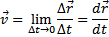
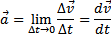
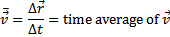
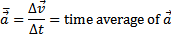


Here, the first three equations are the most fundamental. The first five equations describe vector quantities (position, displacement, velocity, acceleration), and the last two describe scalar quantities (speed, distance).
Equations
(2.1) through (2.6) should be considered as special forms of the above
equations in the case of 1D. As vector additions, subtractions, and
differentiations can be carried out component-wise (Equations (4.13)-(4.16)),
the above equations introduce essentially no additional difficulty compared to
the 1D form (2.1 through 2.6). One thing to note is the “magnitude.” For a
vector in any spatial dimensions, the magnitude – the length of the “arrow” –
can be shown to be the square root of the sum of squares of all components, by
the (repeated) use of the Pythagorean theorem. So, for 2D, speed =  and,
for 1D, speed =
and,
for 1D, speed =  .
.
Example
1. Uniform circular
motion. The position vector on a circle of radius  is given by (see the figure
below):
is given by (see the figure
below):
|
|
|
(5.8) |

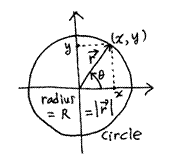 Important
reminders (from LN 1 and calculus):
(1) We use radians for the unit of the angle, unless specified otherwise. (2) (5.8) is valid for any value of
Important
reminders (from LN 1 and calculus):
(1) We use radians for the unit of the angle, unless specified otherwise. (2) (5.8) is valid for any value of
 from
from
 to
to
 ,
not just for, say, the values
in the first quadrant
,
not just for, say, the values
in the first quadrant  .
(3) The positive value of is measured in the
counter-clock-wise fashion, starting from the positive x axis as shown in the
figure. The value of measured
in the clock-wise fashion is defined as negative. (4) Any two values of that differ by
.
(3) The positive value of is measured in the
counter-clock-wise fashion, starting from the positive x axis as shown in the
figure. The value of measured
in the clock-wise fashion is defined as negative. (4) Any two values of that differ by  are
equivalent. For example, all the following values of angle are equivalent:
are
equivalent. For example, all the following values of angle are equivalent:  ,
…
,
…
A
uniform circular motion means that the angle is changing at a constant rate  :
:
|
|
|
(5.9) |

We just
introduced the symbol  (omega,
not double-u) for the angular velocity. [While
(omega,
not double-u) for the angular velocity. [While  is
constant for this example, its more general definition is
is
constant for this example, its more general definition is  and
is then a function
of time.] Question:
what is the acceleration vector
and
is then a function
of time.] Question:
what is the acceleration vector  for
this uniform circular motion?
for
this uniform circular motion?
Solution: First, let us examine what  is.
From Eq. (5.2), (5.8) and (4.16), we get
is.
From Eq. (5.2), (5.8) and (4.16), we get 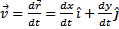 .
From the “chain rule,”
.
From the “chain rule,”  .
The 2nd term in the product is easy:
.
The 2nd term in the product is easy:  from
(5.9). For the 1st term
from
(5.9). For the 1st term  .
We measure in radians, in which case, and only then,
.
We measure in radians, in which case, and only then,  .
Collecting all these results, we get
.
Collecting all these results, we get  .
Similarly,
.
Similarly,  .
Thus,
.
Thus,
|
|
|
(5.10) |

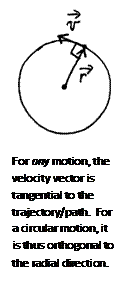 At this point, readers should be
able to show that
At this point, readers should be
able to show that  ,
using (4.7), (5.8) [
,
using (4.7), (5.8) [ and
(5.10)
and
(5.10)  .
This means that the two vectors
.
This means that the two vectors  and
are
orthogonal (or perpendicular) to each other. You should convince yourself that
this orthogonality makes a perfect sense for any circular motion (see the right
figure). Now that we showed
and
are
orthogonal (or perpendicular) to each other. You should convince yourself that
this orthogonality makes a perfect sense for any circular motion (see the right
figure). Now that we showed  and
and
 ,
it is a relatively simple job to take the derivative of (5.10) one more time (
,
it is a relatively simple job to take the derivative of (5.10) one more time ( )
to get
)
to get
|
|
|
(5.11) |
|
|
|
(5.12) |


(5.11) is the answer to this question.
Notice that the magnitude of the acceleration is constant ( since
since
 ),
while the direction is not constant, being exactly the opposite of the position
vector, since is
a negative number times (see
LN 4, “Multiplying a vector by a scalar”). Thus, the vector is
a function of time, i.e. in a circular motion the acceleration vector
is not a constant. Since by definition points
outward from the center of the circle (see the above figure), this means that points
towards the center. This is why (5.11) is called the centripetal
acceleration of a circular motion.
),
while the direction is not constant, being exactly the opposite of the position
vector, since is
a negative number times (see
LN 4, “Multiplying a vector by a scalar”). Thus, the vector is
a function of time, i.e. in a circular motion the acceleration vector
is not a constant. Since by definition points
outward from the center of the circle (see the above figure), this means that points
towards the center. This is why (5.11) is called the centripetal
acceleration of a circular motion.
Uniform circular motion
The above example gave a nice analysis of the uniform circular motion, directly from the general kinematics equations (5.1) through (5.3). The following equations are also essential to understand for a uniform circular motion.
|
Angular speed |
|
(5.13) |
|
Speed |
|
(5.14) |
|
The magnitude of the centripetal acceleration |
|
(5.15) |



Here,  is the period – the time it
takes for one revolution. Since one revolution corresponds to radians, (5.13) is easy to understand: for a
uniform circular motion the angular speed is divided by the period. (5.14) can be interpreted as “for a
uniform circular motion, the speed is
is the period – the time it
takes for one revolution. Since one revolution corresponds to radians, (5.13) is easy to understand: for a
uniform circular motion the angular speed is divided by the period. (5.14) can be interpreted as “for a
uniform circular motion, the speed is  ,” or as the consequence of
taking the magnitude of (5.10) since
,” or as the consequence of
taking the magnitude of (5.10) since  .
Finally, (5.15) is directly obtained from (5.12) and (5.14).
.
Finally, (5.15) is directly obtained from (5.12) and (5.14).
Note that Equations (5.10) and (5.11) can be derived using a geometric method as well. Do read the textbook for that derivation, which I will not cover in the lecture in the interest of time.
Examples 3.7 and 3.8 of the text should be mastered.