Lecture 3
1D Kinematics
Example
1: (2.2 of text)
The altitude of a space shuttle in the first half-minute of the ascent is given
by  ,
with
,
with  .
The instantaneous
velocity at
.
The instantaneous
velocity at  ?
The average velocity between time 0 and ? Sol: By differentiation,
?
The average velocity between time 0 and ? Sol: By differentiation,  . The average velocity,
  .
[This
answer makes sense. Since
.
[This
answer makes sense. Since  is a linear function
of
is a linear function
of  , it follows that the
average velocity is exactly the arithmetic of the initial velocity and the
final velocity. Since the initial velocity is zero,
, it follows that the
average velocity is exactly the arithmetic of the initial velocity and the
final velocity. Since the initial velocity is zero,  .]
.]
Constant acceleration problem in 1D
Using
definitions given in Eqs. (2.2, 2.6), it is possible to obtain  and
and  , given the input
  . This process is generally
called “integrating the equation of motion.” Indeed, if is known, then
. This process is generally
called “integrating the equation of motion.” Indeed, if is known, then  is
simply the indefinite integral of ,
and is
the indefinite integral of . Here, we consider the simplest
case when is
constant, just like in the above example.
is
simply the indefinite integral of ,
and is
the indefinite integral of . Here, we consider the simplest
case when is
constant, just like in the above example.
Good news: (1) This problem is easy. (2) As you will discover, this simple and easy problem forms the backbone of most of the problems in this course.
When confusions
do not arise, physicists tend to re-use certain symbols. Here we have one such
example. We will use the symbol  to
mean a constant value of acceleration for much of the course,
while you are well advised to remember that in Eq. (2.6) is, in general, a function
of time.
to
mean a constant value of acceleration for much of the course,
while you are well advised to remember that in Eq. (2.6) is, in general, a function
of time.
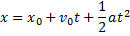
General
solutions for  and
and
 ,
given a constant ,
are
,
given a constant ,
are
|
|
|
(3.1) |
|
|
|
(3.2) |
Why?
Consider solving  for
.
A particular solution is
for
.
A particular solution is  .
The general solution is given by this particular solution plus a constant,
which we set to be
.
The general solution is given by this particular solution plus a constant,
which we set to be  .
The reason is that
.
The reason is that  ,
and so the general solution for has room for an additive
constant. So the solution:
,
and so the general solution for has room for an additive
constant. So the solution:  .
Then, solving
.
Then, solving  proceeds
similarly. A particular solution:
proceeds
similarly. A particular solution:  .
Adding a constant,
.
Adding a constant,  ,
we get:
,
we get:  .
[This
explanation was unnecessary if you are a calculus wizard.]
.
[This
explanation was unnecessary if you are a calculus wizard.]
The following relation is an immediate consequence of the above solution.
|
|
|
(3.3) |
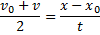
Proof:
From (3.2), we have  ,
the last step using (3.1).
,
the last step using (3.1).
You
should remember a more intuitive proof, as follows. As written, (3.3) is the
statement about the average velocity. The RHS (right hand side) follows
directly from the definition (2.1),  . The LHS (left hand side) follows
from the fact that is
linear in :
in this case, the average velocity is exactly the arithmetic mean of the
initial velocity and the final velocity.
. The LHS (left hand side) follows
from the fact that is
linear in :
in this case, the average velocity is exactly the arithmetic mean of the
initial velocity and the final velocity.
 You should be able to derive
(3.1), (3.2), and (3.3) whenever you need them. Or, recall them and the
derivation of them from your memory. (Although
I will give them in a crib sheet in my exams, the less you need to look them
up, the better you will be in my exams, or other exams for years to come.)
You should be able to derive
(3.1), (3.2), and (3.3) whenever you need them. Or, recall them and the
derivation of them from your memory. (Although
I will give them in a crib sheet in my exams, the less you need to look them
up, the better you will be in my exams, or other exams for years to come.)
Also,
by eliminating t in (3.1) and (3.3), one can obtain this useful relation:
 .
[The
physics of this relation is the very important “Work-Energy theorem.” Until we
study that theorem, I don’t recommend that you just memorize this relation,
while you can use it. After we study the work-energy theorem, you won’t have
to remember this relation – it will just come to you.]
.
[The
physics of this relation is the very important “Work-Energy theorem.” Until we
study that theorem, I don’t recommend that you just memorize this relation,
while you can use it. After we study the work-energy theorem, you won’t have
to remember this relation – it will just come to you.]
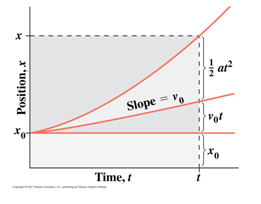
The
general solution for can
be visualized as in the right figure.
Example
2: (2.3 of
text) Stopping distance. Landing a jetliner. A jetliner touches down
at 270 km/h. It decelerates at 4.5  .
What is the stopping distance (
.
What is the stopping distance ( )?
Sol: Take the axis
so that its origin is at the touch down point and the plane moves in the
positive direction. .
)?
Sol: Take the axis
so that its origin is at the touch down point and the plane moves in the
positive direction. .
 .
Now, let us define
.
Now, let us define  =
time when the plane stops, then at
=
time when the plane stops, then at  ,
,
 and
and
 .
Then,
.
Then,  means
means
 and
and

 .
.
 km/h
and
km/h
and  .
Important:
.
Important:  ,
because “pushes”
the plane to the negative direction of the axis.
,
because “pushes”
the plane to the negative direction of the axis.  m/s
= 75 m/s. So,
m/s
= 75 m/s. So,  m.
Note that this example is applicable to the problem of stopping a car, in which
case the source of is
only the friction between the car and the road. Since increases rapidly as increases
(
m.
Note that this example is applicable to the problem of stopping a car, in which
case the source of is
only the friction between the car and the road. Since increases rapidly as increases
( ),
it is not a good idea to drive fast on a wet day.
),
it is not a good idea to drive fast on a wet day.
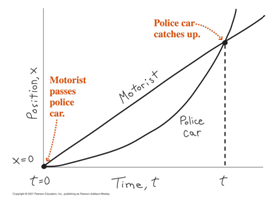 Example 3: (2.4 of text) You drive at 75
km/h (21 m/s), in the 50 km/h zone, and the police car starts from rest to tail
you, with acceleration 2.5 .
When the police officer catches you up, how far down the road are we, and how
fast is the police car running? Sol:
Example 3: (2.4 of text) You drive at 75
km/h (21 m/s), in the 50 km/h zone, and the police car starts from rest to tail
you, with acceleration 2.5 .
When the police officer catches you up, how far down the road are we, and how
fast is the police car running? Sol:  (you)
and
(you)
and  (police
car).
(police
car).  has
two solutions:
has
two solutions:  (initially)
and
(initially)
and  (catch-up).
At catch-up,
(catch-up).
At catch-up,  =
3.5E2 m, and
=
3.5E2 m, and  m/s.
The last answer (
m/s.
The last answer ( )
makes sense since the average velocity should be the same between the two
motions.
)
makes sense since the average velocity should be the same between the two
motions.
Free fall
Here “free” means free of other influences than gravity, and “fall” … well, it doesn’t really mean a fall … you best understand it as the motion under the influence of the gravitational pull. The definition: a free fall is the motion of an object under the influence of gravity alone.
According to this definition, the earth is perpetually free-falling towards the Sun. This is quite true. The (nearly) circular motion of the Earth round the Sun is the result of that perpetual free fall. Of course, apple falling from a tree is also a free fall, if the air resistance is negligible. [This insight – the equivalence of the apple falling and the Earth going round the Sun – may seem trivial, but the power of this insight brought by Newton, in terms of its influence on physics in general, is beyond description.] If you toss your baseball up into the air, then the entire motion – including going up and coming down – is a free fall.
Here, we
consider free fall motions near the surface of the Earth, so that the constant
acceleration applies. In this case,  is
all we need to describe the gravity. This is the so-called “surface gravity,”
the downward acceleration due to the Earth’s pull. There are two comments about
applying (3.1-3) to this free fall problem. (i) For motion in the vertical
direction, we tend to use the symbol
is
all we need to describe the gravity. This is the so-called “surface gravity,”
the downward acceleration due to the Earth’s pull. There are two comments about
applying (3.1-3) to this free fall problem. (i) For motion in the vertical
direction, we tend to use the symbol  in
place of .
(ii) If we take the axis
as pointing up, then
in
place of .
(ii) If we take the axis
as pointing up, then  ,
and if we take the axis
is as pointing down, then
,
and if we take the axis
is as pointing down, then  . Which choice to take is a
matter of convenience.
. Which choice to take is a
matter of convenience.
Example
4. (2.5 of
text) A diver drops from a 10 m high cliff. At what speed does he enter the
water, and how long is he in the air? Sol: It is most convenient to take the axis as pointing down for this
problem with  initially.
Then, .
When he enters the water,
initially.
Then, .
When he enters the water,  and
and  .
Here,
.
Here,  m
is the height of the cliff. The 2nd equation gives
m
is the height of the cliff. The 2nd equation gives  .
Inserting this to the first equation,
.
Inserting this to the first equation,  .
Evaluating these expressions with m
and ,
we get
.
Evaluating these expressions with m
and ,
we get  14
m/s, and
14
m/s, and  1.4
s.
1.4
s.
Example
5. (2.6 of
text) You toss a ball straight up at  7.3
m/s, leaving your hand at 1.5 m above the floor. Find (1) when it hits the
floor, (2) the maximum height it reaches, and (3) its speed when it passes your
hand on the way down.
7.3
m/s, leaving your hand at 1.5 m above the floor. Find (1) when it hits the
floor, (2) the maximum height it reaches, and (3) its speed when it passes your
hand on the way down.
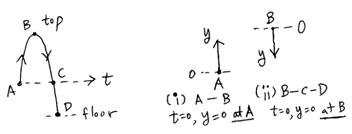 Solution:
This
problem is somewhat complicated. When approached in a straightforward way (as
in text), one has to solve a quadratic equation. That is one way to go. Here,
I present another, more physical, method. We divide the motion into two parts,
(i) going up to the top and (ii) coming down, all the way to the floor. We treat
them separately with completely different coordinate systems. As shown
in the figure, we take the axis pointing up for (i), and
the axis
pointing down for (ii). Also, note that the zeroes for and are taken differently.
For
motion (i),  and
and
 .
When the ball reaches the top, ,
and so the time it reaches the top, let us define it as
.
When the ball reaches the top, ,
and so the time it reaches the top, let us define it as  ,
is given by
,
is given by  .
Thus,
.
Thus,  .
The height that the ball traveled during is
given by
.
The height that the ball traveled during is
given by  =
=
 =
=
 [note
the similarity to Example 2, the stopping distance problem].
[note
the similarity to Example 2, the stopping distance problem].  2.72
m (keep
one more sig-fig here, because we will re-use this number below). This gives the answer for
(2) +
1.5 = 4.2 m.
2.72
m (keep
one more sig-fig here, because we will re-use this number below). This gives the answer for
(2) +
1.5 = 4.2 m.
For
motion (ii), and
 .
It may not surprise you that for the ball to come down by ,
the time it takes is given by (from the 2nd equation),
.
It may not surprise you that for the ball to come down by ,
the time it takes is given by (from the 2nd equation),  =
=
 =
!
This gives the answer to (3): =
7.3 m/s. The ball is coming down at the same speed as it went up. [We
just proved that the motion up and the motion down are completely symmetric.
Consider it as proving your intuition based on the movie-played-backward trick.] The total range of motion for
motion (ii) is
=
!
This gives the answer to (3): =
7.3 m/s. The ball is coming down at the same speed as it went up. [We
just proved that the motion up and the motion down are completely symmetric.
Consider it as proving your intuition based on the movie-played-backward trick.] The total range of motion for
motion (ii) is  m
and the corresponding time is, from ,
given by
m
and the corresponding time is, from ,
given by 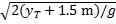 .
.
The
total time for (i) and (ii) is then  =
=
 =
1.7 s, which is the answer to (1).
=
1.7 s, which is the answer to (1).