Lecture 2
Dimension and 1D Kinematics
Dimension
The dimension
can be considered as an abstraction of the unit, and is defined as follows. If
the SI unit of a physical quantity Q is  ,
then the dimension of
Q is defined as
,
then the dimension of
Q is defined as  (L=length,
M=mass, T=time).
(L=length,
M=mass, T=time).
Note:
(1)
The dimension
of a physical quantity is unique, but the unit is not. For example, a velocity
can be expressed as 40 mph or 20 m/s, but its dimension is always  .
.
(2) If A = B, then the dimension of A = the dimension of B. Put another way, if two quantities have different dimensions, they cannot be equal (and thus, they cannot be compared either).
Example
1: The
dimension of the area is  (the
SI unit of the area is
(the
SI unit of the area is  ;
or remember that we measure areas in “square feet”) and the dimension of the
volume is
;
or remember that we measure areas in “square feet”) and the dimension of the
volume is  (the
SI unit of area is
(the
SI unit of area is  ;
or remember that we measure volume in “qubic feet”).
;
or remember that we measure volume in “qubic feet”).
What is the dimension good for?
If you get in the habit of checking the dimension of your answer, that is a habit that can go a long way to make you a good student and a good scientist. I believe that all scientists have this habit. The dimension is also the basis of the so-called “dimensional analysis,” which is a very useful technique. Both points are illustrated by the following simple example.
Example
2: Given the
radius of  m
and the mass
m
and the mass  kg
(for more exact numbers, see the inside cover of the textbook) of the Earth,
what is the average density of the Earth? Since the density = mass / volume,
we need to express volume,
kg
(for more exact numbers, see the inside cover of the textbook) of the Earth,
what is the average density of the Earth? Since the density = mass / volume,
we need to express volume,  , in terms of given quantities,
  and
and  . Scenario 1. You are a
math wizard, and you use your multi-dimensional integral calculus skill to derive
. Scenario 1. You are a
math wizard, and you use your multi-dimensional integral calculus skill to derive
 .
Alas, dimension-wise, this equation does not make sense, since it implies
.
Alas, dimension-wise, this equation does not make sense, since it implies  (cf.
the note point (2) above). Realizing this, you check your calculation and, sure
enough, find that you dropped a power of , and correct your expression to
(cf.
the note point (2) above). Realizing this, you check your calculation and, sure
enough, find that you dropped a power of , and correct your expression to  ,
to proceed to the correct answer: density =
,
to proceed to the correct answer: density =  (this
answer is not terribly accurate, since and were given with only one
significant figure). Scenario 2. Suppose this was a multiple-choice
question for your MCAT/GRE/GMAT exam with the following choice of answers:
(this
answer is not terribly accurate, since and were given with only one
significant figure). Scenario 2. Suppose this was a multiple-choice
question for your MCAT/GRE/GMAT exam with the following choice of answers:

You are not given the formula ,
which you don’t remember and don’t have time to figure out. What to do? Do
not panic, as the dimensional analysis can come to the rescue! Note
that the dimension of the volume is  ,
and so it must be that
,
and so it must be that  (Why?
The dimension of is
(Why?
The dimension of is
 ,
and the dimension of is
.
So the only combination of and to give the dimension is
,
and the dimension of is
.
So the only combination of and to give the dimension is
 .)
Thus,
.)
Thus,  ,
i.e. density equals
,
i.e. density equals  up
to a numerical factor. You then make an educated guess that this numerical
factor is on the order of 1: i.e. it could be, say, 0.7 or 5, but it just
cannot be, say, 300 or 0.05. Thus, you are pretty sure that the density
up
to a numerical factor. You then make an educated guess that this numerical
factor is on the order of 1: i.e. it could be, say, 0.7 or 5, but it just
cannot be, say, 300 or 0.05. Thus, you are pretty sure that the density  .
So, you can choose with confidence that (c) is the correct answer. Your answer
is about 5 times too large, which is not surprising at all for a dimensional
analysis. While this example is very simple, the insight given by the
dimensional analysis is extremely valuable for many difficult real life
problems.
.
So, you can choose with confidence that (c) is the correct answer. Your answer
is about 5 times too large, which is not surprising at all for a dimensional
analysis. While this example is very simple, the insight given by the
dimensional analysis is extremely valuable for many difficult real life
problems.
Order of magnitude estimate
As a rule, an order of magnitude (“ballpark”) estimate of an unknown physical quantity of interest is very valuable, since it is much more quickly obtained than a numerically precise answer. For a solvable problem, a ballpark estimate should be compared with the precise answer. If they do not agree within the order of magnitude, then it probably means that there were some mistakes made in the (presumably) lengthy process of obtaining the precise answer. For an unsolved problem, an order of magnitude estimate is the only answer! [The order of magnitude estimate is closely related to the dimensional analysis described above.]
Example
3: [Wolfson 1.4]
How many cells are in a brain? Circumference ~ 2.5 “span.” 2 r = 2.5 “span”. 2r ~ 9 inches ~
20 cm. Subtract ~ 5 cm for skull bones. 2r ~ 15 cm. Cube it ~ 3E3
r = 2.5 “span”. 2r ~ 9 inches ~
20 cm. Subtract ~ 5 cm for skull bones. 2r ~ 15 cm. Cube it ~ 3E3  =
3E-3
=
3E-3  to
get the volume of a brain. How about the size of a cell? Red blood cell has
diameter ~ 10
to
get the volume of a brain. How about the size of a cell? Red blood cell has
diameter ~ 10  m
=
m
=  m.
So a cell volume ~
m.
So a cell volume ~  .
So, taking the ratio = brain-vol/cell-vol, we get ~ 3E12 cells. Not too bad!
.
So, taking the ratio = brain-vol/cell-vol, we get ~ 3E12 cells. Not too bad!
1D Kinematics
Kinematics
Kinematics means study of motion without specifying the cause of motion. As opposed to dynamics. 1D = one dimension(al). 2D = two dimensional/dimensions…
Velocity and speed – a simple introduction
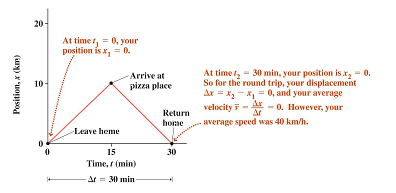
The
figure shows a simple sequence of motion, which are summarized in the table
below. In the table note
some standard notations: the subscript  meaning “initial” as in
  ,
the subscript
,
the subscript  meaning
“final” as in
meaning
“final” as in  ,
the
,
the  (Delta
– another Greek letter) symbol meaning “the change of” as in
(Delta
– another Greek letter) symbol meaning “the change of” as in  and
and
 .
.
|
|
|
|
|
|
|
|
|
|
|
|
|
(min) |
(min) |
(km) |
(km) |
|
|
= distance |
(km/h) |
(km/h) |
|
1st leg |
0 |
15 |
0 |
10 |
15 |
10 |
10 |
40 |
40 |
|
2nd leg |
15 |
30 |
10 |
0 |
15 |
-10 |
10 |
-40 |
40 |
|
Round trip |
0 |
30 |
0 |
0 |
30 |
0 |
20 |
0 |
40 |


Here,
the last two columns represent two ways of measuring how fast the trip was. Let
us define some terms here. We define as
the displacement (change in position),  as
the average velocity. Note that the displacement is a signed number,
depending on the sense of direction, and so is the average velocity. The
position, the displacement, and the average velocity each have both the
magnitude and the direction – they are vector quantities. In contrast,
quantities with no sense of direction are called scalar quantities.
Here, the distance (
as
the average velocity. Note that the displacement is a signed number,
depending on the sense of direction, and so is the average velocity. The
position, the displacement, and the average velocity each have both the
magnitude and the direction – they are vector quantities. In contrast,
quantities with no sense of direction are called scalar quantities.
Here, the distance ( )
and /t
(the average speed) are scalar quantities.
)
and /t
(the average speed) are scalar quantities.
Position, velocity and acceleration
In the above example, long time intervals (15 or 30 minutes) were considered. When the time interval of consideration becomes very very small (“zero within the error” in the physics sense; “infinitesimal” in the mathematical sense), we then talk about “instantaneous” quantities. So, we come to very important definitions.
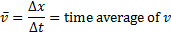
|
Average velocity |
|
(2.1) |
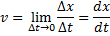
|
Instantaneous velocity |
|
(2.2) |
|
Average speed |
Time average of the instantaneous
speed |
(2.3) |
|
Instantaneous speed |
The magnitude of the instantaneous velocity |
(2.4) |
|
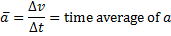
Average acceleration |
|
(2.5) |
|
Instantaneous acceleration |
|
(2.6) |

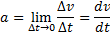
Note:
(1)
The position
( ),
the instantaneous velocity (
),
the instantaneous velocity ( ) and the instantaneous acceleration
(
) and the instantaneous acceleration
( )
are the most fundamental quantities here.
Incidentally, all of these are vector quantities.
)
are the most fundamental quantities here.
Incidentally, all of these are vector quantities.
(2)
Nearly always
the adjective “instantaneous” for and
can
be omitted, since the instantaneous nature is obvious from context.
(3)
From the above
definition, is
the time-derivative of ,
and is
the time-derivative of .
Thus,  gives
the tangential slope of the graph
gives
the tangential slope of the graph  ,
and
,
and  gives
the tangential slope of the graph .
You should carefully study figures 2.4, 2.5, and 2.7 of Wolfson and understand
them thoroughly, from this point of view.
gives
the tangential slope of the graph .
You should carefully study figures 2.4, 2.5, and 2.7 of Wolfson and understand
them thoroughly, from this point of view.