 Research in the Gweon Group
| Differences between revisions 1 and 23 (spanning 22 versions) | Back to page |
|
Size: 77
Comment:
|
Size: 1575
Comment:
|
| Deletions are marked like this. | Additions are marked like this. |
| Line 1: | Line 1: |
| = Extremely Correlated Fermi Liquid = | == Strange ARPES line shapes and ECFL == |
| Line 3: | Line 3: |
| This is a very interesting model!! | <<fl(E)>>ver since high temperature superconductors have been known to scientists, they have been quite baffling. The central question is whether the standard textbook theories that we know and love already are applicable to these fascinating materials. The general sense is that those standard theories must be augmented to a great extent, if not replaced completely. Why? It is because of many puzzling experimental results that defy a proper understanding. ARPES results are among the most mysterious! [[http://www-ssrl.slac.stanford.edu/research/highlights_archive/htsc.pdf|{{attachment:SSRL-ECFL-Advertisement.png}}]] As the above advertisement says, we might be onto solving this conundrum! Links: * The paper can be accessed from <<doi("10.1103/PhysRevLett.107.056404","here")>> or <<ln("http://arxiv.org/abs/1104.2631", "here (public)")>>. * My invited talk at the March meeting 2012: <<ln("http://meetings.aps.org/Meeting/MAR12/Event/160938", "abstract")>> and <<ln("http://absuploads.aps.org/presentation.cfm?pid=10188", "presentation")>>. * <<ln("http://www-ssrl.slac.stanford.edu/newsletters/headlines/headlines_10-11.html#Highlight1", "A news article about our work at the Stanford Synchrtron Lightsource")>>. * <<ln("http://www-ssrl.slac.stanford.edu/research/highlights_archive/htsc.pdf", "A science highlight article about our work at the Stanford Synchrtron Lightsource")>>. * <<ln("http://news.ucsc.edu/2011/07/high-temperature-superconductors.html", "News article at UC Santa Cruz")>>. |
Strange ARPES line shapes and ECFL
Ever since high temperature superconductors have been known to scientists, they have been quite baffling. The central question is whether the standard textbook theories that we know and love already are applicable to these fascinating materials. The general sense is that those standard theories must be augmented to a great extent, if not replaced completely. Why? It is because of many puzzling experimental results that defy a proper understanding. ARPES results are among the most mysterious!
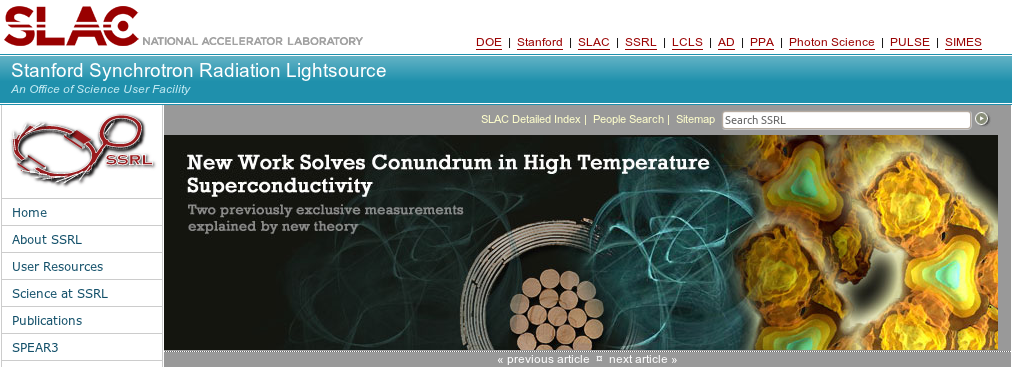
As the above advertisement says, we might be onto solving this conundrum!
Links:
The paper can be accessed from here or here (public).
My invited talk at the March meeting 2012: abstract and presentation.
A news article about our work at the Stanford Synchrtron Lightsource.
A science highlight article about our work at the Stanford Synchrtron Lightsource.