 Research in the Gweon Group
| Differences between revisions 20 and 48 (spanning 28 versions) | Back to page |
|
Size: 3105
Comment:
|
← Revision 48 as of 1:30PM, Oct 29, 2014 ⇥
Size: 3943
Comment:
|
| Deletions are marked like this. | Additions are marked like this. |
| Line 3: | Line 3: |
| <<fl(W)>>e had success in explaining the ARPES data using the so-called [[sECFL|“simple” extremely correlated Fermi liquid (sECFL)]] theory. | <<fl(W)>>e had success in explaining the ARPES data using the so-called [[sECFL|“simplified” Extremely Correlated Fermi Liquid (sECFL)]] theory. |
| Line 9: | Line 9: |
| <<lia("Fig1.png", width = 60%, align = right, url = "http://arxiv.org/abs/1212.0299")>> ARPES researchers in high temperature superconductors have not figured out yet how to analyze the ARPES data ''wholly'' as a two dimensional function $A(k,\omega)$, a function of $k$ and $\omega$. Why not? The reasons are both technical and physical. At this point, it suffices to note that researchers analyze EDCs (EDC is an energy distribution curve given by $A(k,\omega)$ at a fixed $k$ value) or MDCs (MDC is a momentum distribution curve given by $A(k,\omega)$ at a fixed $\omega$ value) ''separately.'' |
<<lia("Fig1.png", width = 60%, align = right, url = "http://arxiv.org/abs/1212.0299")>> ARPES researchers studying high temperature superconductors have not figured out yet how to analyze the ARPES data ''wholly'' as a two dimensional function $A(k,\omega)$, a function of $k$ and $\omega$. Why not? The reasons are both technical and physical. At this point, it suffices to note that researchers analyze EDCs (EDC is an energy distribution curve given by $A(k,\omega)$ at a fixed $k$ value) or MDCs (MDC is a momentum distribution curve given by $A(k,\omega)$ at a fixed $\omega$ value) ''separately.'' |
| Line 16: | Line 15: |
| <<lia("Fig2.png", width = 60%, align = left, url = "http://arxiv.org/abs/1212.0299")>> It turns out that in [[sECFL|our initial work]], we could describe EDCs but not MDCs. This was what was wanting from an experimentalist's point of view. So, I embarked on improving the model. I came up with couple of ideas that worked for two different families of high temperature superconductors. In this work, for the first time, we have shown that it is possible to described EDCs and MDCs of high temperature superconductors on equal footing using a microscopically based model. This is an unprecedented achievement. For this, we had to modify the original ECFL model (“simple ECFL”) in a phenomenological way to make this work: the resulting model is thus called the phenomenological ECFL (pECFL) model. | <<lia("Fig2.png", width = 60%, align = left, url = "http://arxiv.org/abs/1212.0299")>> It turns out that in [[sECFL|our initial work]], we could describe EDCs but not MDCs. This was what was wanting from an experimentalist's point of view. So, I embarked on improving the model. I came up with couple of ideas that worked for two different families of high temperature superconductors. In this work, for the first time, we have shown that it is possible to described EDCs (above) and MDCs (left) of high temperature superconductors on equal footing using a microscopically based model. This is an unprecedented achievement. For this, we had to modify the original ECFL model (“simplified ECFL”) in a phenomenological way: the resulting model is thus called the phenomenological ECFL (pECFL) model. |
| Line 20: | Line 19: |
| Quite pleasantly, we find, through [[nMBDOS|our very comprehensive experimental work]], that this phenomenological change is actually quite important: it seems to connect nicely to features that are related to the superconductivity itself! Follow the links below, to learn more about this emerging picture. | Quite pleasantly, we find, through [[nMBDOS|our very comprehensive experimental work]], that this phenomenological change may actually be quite important: it seems to connect nicely to features that are related to the superconductivity itself! Follow the links below, to learn more about this emerging picture. |
| Line 22: | Line 21: |
| == Links == | == aECFL == |
| Line 24: | Line 23: |
| * <<ln("http://arxiv.org/abs/1212.0299", "The manuscript")>> * [[sECFL|Simple ECFL]] |
Recently, we have come up with a more accessible variant of the pECFL. We have named it aECFL, since the parameter that goes into this model is named $a$. Or, perhaps it could be interpreted as an ''accessible'' ECFL. Students Kazue Mastuyama and Rohit Dilip have been actively working on this project in 2014, and a new manuscript will be available soon. In the mean timne, here is a <<la(Dilip_aECFL_paper.pdf, write-up by the excellent summer intern student Rohit)>>. == Links, Students == * The paper can be accessed from <<ln("http://link.aps.org/doi/10.1103/PhysRevLett.111.246401","here")>> or <<ln("http://arxiv.org/abs/1212.0299", "here (public)")>>. * [[sECFL|Simplified ECFL]] |
| Line 27: | Line 32: |
| * Kazue Matsuyama (grad student) helped with this project, and did a wonderful job. She will continue expanding this project. In summer of 2014, Rohit Dilip has pushed the aECFL project along wonderfully. |
Phenomenological ECFL
We had success in explaining the ARPES data using the so-called “simplified” Extremely Correlated Fermi Liquid (sECFL) theory.
However, from an experimentalist's point of view, this work had something still wanting. Why? To explain, let us note that the ARPES data give the single-particle spectral function $A(k, \omega)$, where $\hbar k$ is the momentum and $\hbar \omega$ is the negative energy of the electronic state measured. In ARPES, the data corresponding to the momentum along one direction (“cut”) is obtained as one unit of data. So, $\hbar k$ gives the momentum value along a given ARPES cut.
EDCs and MDCs
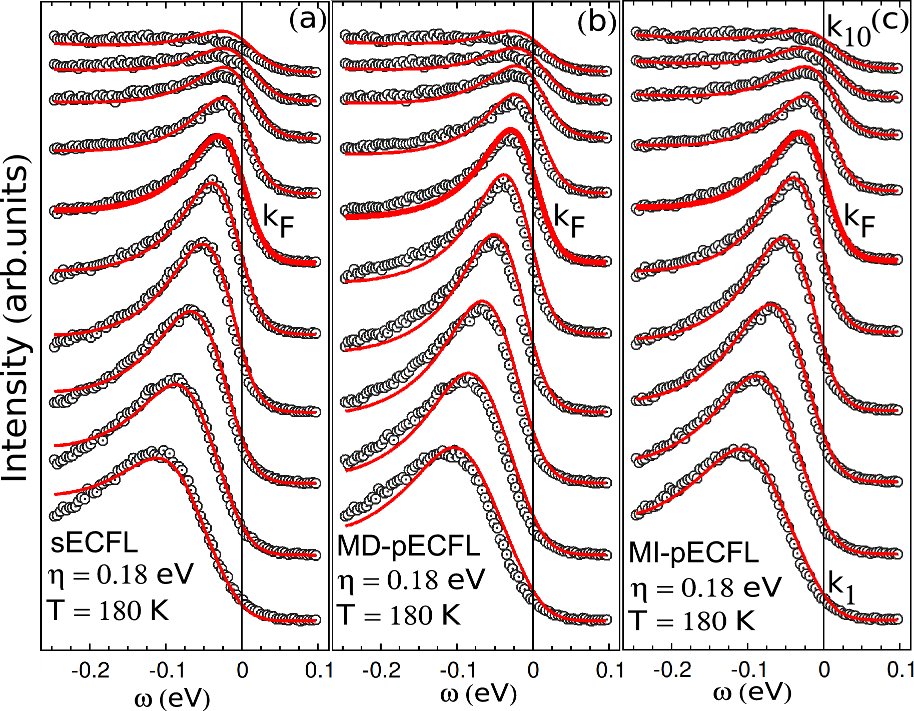 ARPES researchers studying high temperature superconductors have not figured out yet how to analyze the ARPES data wholly as a two dimensional function $A(k,\omega)$, a function of $k$ and $\omega$. Why not? The reasons are both technical and physical. At this point, it suffices to note that researchers analyze EDCs (EDC is an energy distribution curve given by $A(k,\omega)$ at a fixed $k$ value) or MDCs (MDC is a momentum distribution curve given by $A(k,\omega)$ at a fixed $\omega$ value) separately.
When ARPES was applied to high temperature superconductors initially, researchers focused on EDCs, as the EDC is commonly viewed as more fundamental for good reasons. However since around 2000, ARPES researchers fell in love with MDCs, due to the practical reason that MDCs are easier to analyze. And, it seemed that they give useful information, if one makes certain assumptions such as the momentum-independent Dyson self energy.
pECFL does it all
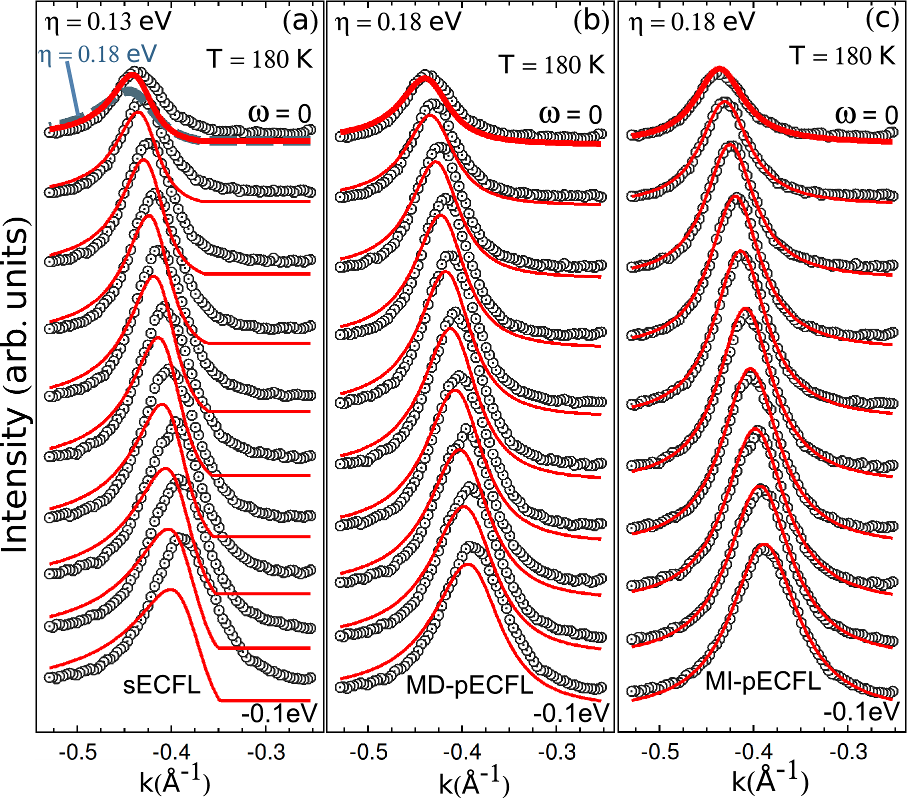 It turns out that in our initial work, we could describe EDCs but not MDCs. This was what was wanting from an experimentalist's point of view. So, I embarked on improving the model. I came up with couple of ideas that worked for two different families of high temperature superconductors. In this work, for the first time, we have shown that it is possible to described EDCs (above) and MDCs (left) of high temperature superconductors on equal footing using a microscopically based model. This is an unprecedented achievement. For this, we had to modify the original ECFL model (“simplified ECFL”) in a phenomenological way: the resulting model is thus called the phenomenological ECFL (pECFL) model.
What does it mean?
Quite pleasantly, we find, through our very comprehensive experimental work, that this phenomenological change may actually be quite important: it seems to connect nicely to features that are related to the superconductivity itself! Follow the links below, to learn more about this emerging picture.
aECFL
Recently, we have come up with a more accessible variant of the pECFL. We have named it aECFL, since the parameter that goes into this model is named $a$. Or, perhaps it could be interpreted as an accessible ECFL.
Students Kazue Mastuyama and Rohit Dilip have been actively working on this project in 2014, and a new manuscript will be available soon. In the mean timne, here is a write-up by the excellent summer intern student Rohit.
Links, Students
The paper can be accessed from here or here (public).
- Kazue Matsuyama (grad student) helped with this project, and did a wonderful job. She will continue expanding this project. In summer of 2014, Rohit Dilip has pushed the aECFL project along wonderfully.