 Research in the Gweon Group
Anomalous nodal many body density of states
The density of states (DOS) is a basic quantity, e.g., in the theory of free/band electrons in a solid. The electron DOS says how many electrons the material can accommodate at a certain energy value.
In a strongly correlated electron system such as high temperature superconductors, the equivalent quantity is the many body density of states (MBDOS), $\int d\vec k A(\vec k, \omega)$, where $A$ is the single particle spectral function, measured by ARPES. Even when the DOS is predicted to be finite at the Fermi energy (“band metal”), strong correlation can lead to a vanishing MBDOS (“Mott-Hubbard insulator”).
A very important question that has been very tough to answer so far is “does the Mott insulator physics have a distinct signature for a nearly optimally doped high temperature superconductor?” Such a signature will dramatically deepen our understanding of the so-called strange metal phase or the bad metal phase of high temperature supercoductors.

The discovery
ARPES is a recognized main tool for studying many body interactions in cuprates (and other hot materials such as graphene and topological insulators). Here at UCSC, we have taken some unique data for the past few years. The unique data that we have obtained at the SSRL (Stanford) and the ALS (Berkeley) have led to the discovery of a new anomaly in ARPES. This is a new anomaly, since it is experimentally quite distinct from the two anomalies the field is already quite familiar with: the low energy dispersion anomaly and the high energy dispersion anomaly; dispersion anomaly = “kink” in common ARPES lingo. The above image summarizes these two known anomalies in a visualization method that I invented (click the image to learn more details).
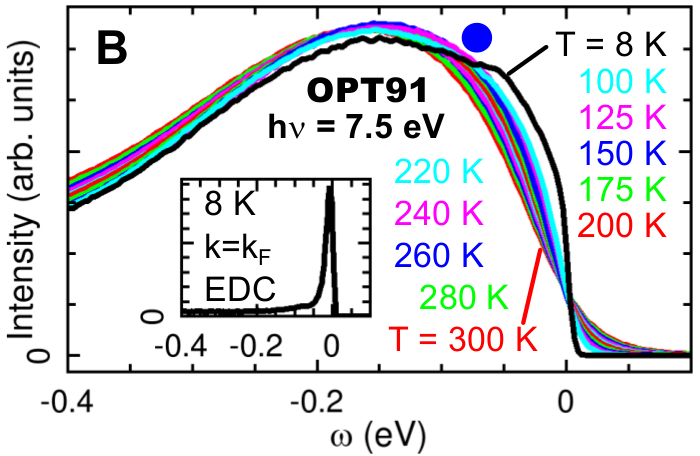 The nMBDOS anomaly, discovered here at UC Santa Cruz (see the left image, for example), implies that the following two ingredients are important for the theory of high temperature superconductors: electron-hole asymmetry and k-dependent Dyson self energy. Since it is a bit mouthful to say “the nMBDOS anomaly,” it seems more convenient to call it simply the ARPES (nodal) DOS anomaly.
What does it mean, really?
This is a unique ARPES signature of the strange/bad metal phase of high Tc. The Mott insulator physics is important for an extended doping range around the optimal doping. It also shows that the phenomenological modification introduced for the phenomenological ECFL model may be important for the superconductivity. For details, please read the manuscript. A very general introduction to the puzzle of the high temperature superconductivity and its relation to our work is given here.
Links+
- All ARPES data used in the above paper are the UCSC data obtained by the Gweon group at the SSRL and the ALS.