 Research in the Gweon Group
| Differences between revisions 1 and 13 (spanning 12 versions) | Back to page |
|
Size: 811
Comment:
|
Size: 1208
Comment:
|
| Deletions are marked like this. | Additions are marked like this. |
| Line 7: | Line 7: |
| We are studying Fermi surface, charge ordering gap, and spin gap, which are all essential to the discussion of the cuprate physics in general. We have one of the best ARPES results, and can resolve the band structure the best. | <<lia("Fig4.png", align = left, width = 60%, clickable = False)>> We are studying Fermi surface, charge ordering gap, and spin gap, which are all essential to the discussion of the cuprate physics in general. We have one of the best ARPES results, and can resolve the band structure the best (see the image shown on the left). Due to the one dimensional nature of this material, the ARPES intensity at the chemical potential ($E = 0$ in the figure) is very low. However, we got very good results as shown here, where the two bands are clearly resolved for the first time (panels c,d,e). |
| Line 11: | Line 14: |
| * Gregory Kaminsky is actively involved in this project, and he is writing up a manuscript. | * Gregory Kaminsky (grad student) is actively involved in this project in a leading role, and he is preparing a manuscript. |
Two leg ladder compounds
Two leg ladder compounds are quasi-one dimensional cuprates that are famous for sharing certain key properties of quasi-two dimensional cuprates. As the many body theory is more conclusive for one-dimensional systems, quasi-one dimensional cuprates are nice reference systems to study.
For this reason, in the Gweon group, we study two leg ladder compounds, in addition to quasi-two dimensional cuprates (Bi2212, NaCCOC, LSCO).
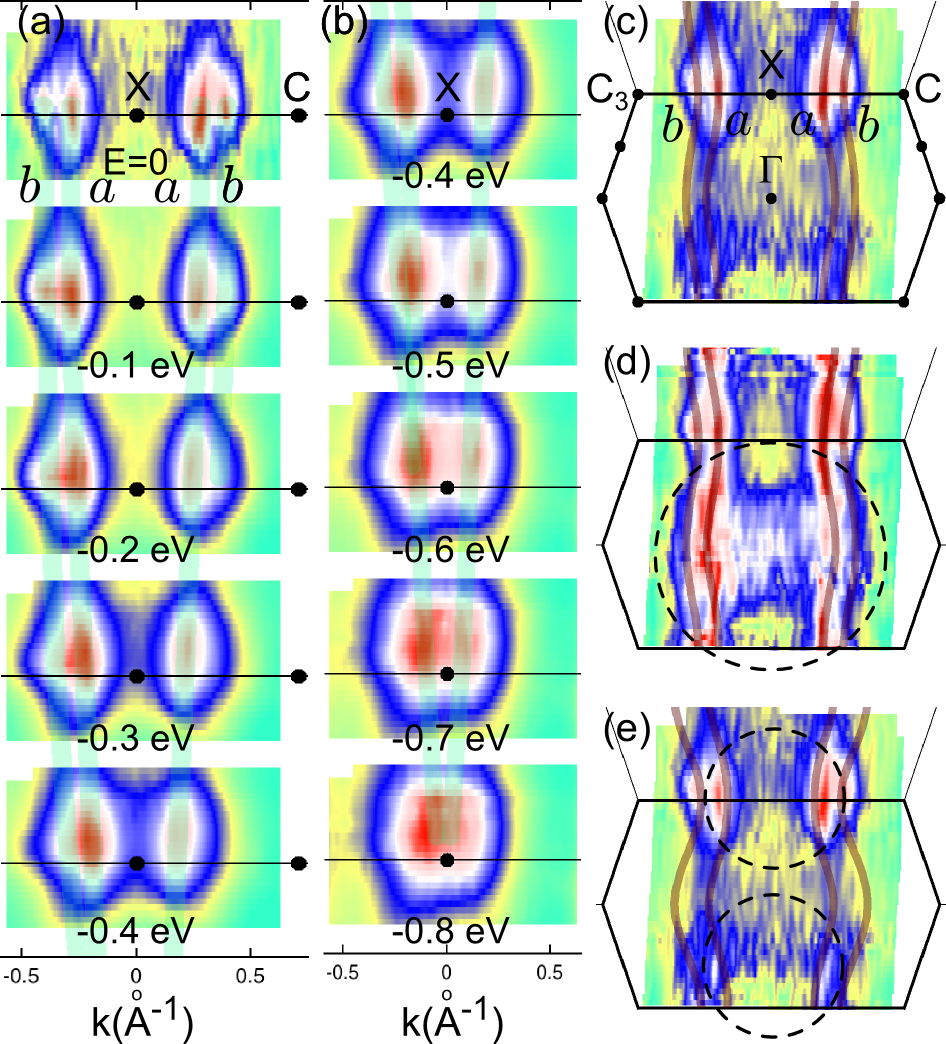 We are studying Fermi surface, charge ordering gap, and spin gap, which are all essential to the discussion of the cuprate physics in general. We have one of the best ARPES results, and can resolve the band structure the best (see the image shown on the left).
Due to the one dimensional nature of this material, the ARPES intensity at the chemical potential ($E = 0$ in the figure) is very low. However, we got very good results as shown here, where the two bands are clearly resolved for the first time (panels c,d,e).
Student
- Gregory Kaminsky (grad student) is actively involved in this project in a leading role, and he is preparing a manuscript.