 Research in the Gweon Group
| Differences between revisions 1 and 9 (spanning 8 versions) | Back to page |
|
Size: 1568
Comment:
|
Size: 2250
Comment:
|
| Deletions are marked like this. | Additions are marked like this. |
| Line 3: | Line 3: |
| In studying high temperature superconductors, what can be explained by a textbook Fermi liquid theory and what cannot be is a central question. This is generally easier said than done, because an exotic theory can look like a textbook theory when low energy excitations are examined. So, the correct question to ask is whether the *exotic strong correlation* physics is first or the textbook *Fermi liquid* physics is first. | In studying high temperature superconductors, what can be explained by a textbook Fermi liquid theory and what cannot be is a central question. This is generally easier said than done, because an exotic theory can look like a textbook theory when low energy excitations are examined. So, the correct question to ask is whether the ''exotic strong correlation'' physics is first or the textbook ''Fermi liquid'' physics is first. |
| Line 5: | Line 5: |
| In addressing this question, the so-calle Na-oxychloride superconductors (NaCCOC) are valuable. Here in this work, we studied these rarely obtainable high quality crystals at UCSC. The data taken at UCSC definitely indicate that the *exotic strong correlation physics* is the primary physics to be considered first. This conclusion is drawn by carefully stuyding the Fermi surface geometry and correlating it with the known charge ordering wave vectors for NaCCOC. | In addressing this question, the so-calle Na-oxychloride superconductors (NaCCOC) are valuable. Here in this work, we studied these rarely obtainable high quality crystals at UCSC. The data taken at UCSC definitely indicate that the ''exotic strong correlation physics'' is the primary physics to be considered first. This conclusion is drawn by carefully stuyding the Fermi surface geometry and correlating it with the known charge ordering wave vectors for NaCCOC. [[http://dx.doi.org/10.1103/PhysRevB.84.060513|{{attachment:FS-and-CO.png}}|class=none]] |
| Line 11: | Line 13: |
| == Links == | == Relation to the study of strange metal phase == |
| Line 13: | Line 15: |
| * The paper can be accessed from <<doi("10.1103/PhysRevB.84.060513","here")>> or <<ln("http://arxiv.org/abs/1010.5459", "here (public)")>> | Our studies of the strange metal phase ([[sECFL]], [[pECFL]], [[nMBDOS]]) show that the extreme correlation is important. The study of charge order here agrees on that. However, this study is related to the so-called pseudo-gap phase, not the strange metal phase. Of course, the eventual theory of superconductivity should address all phases: the strange normal phase, the pseudo-gap phase, and the superconducting phase. == Links, data == * The paper can be accessed from <<doi("10.1103/PhysRevB.84.060513","here (PRB, Rapid Communications)")>> or <<ln("http://arxiv.org/abs/1010.5459", "here (public access)")>>. |
| Line 16: | Line 22: |
* Jianqiao Meng (postdoc), Matt Brunner (grad student) |
Charge ordering in NaCCOC
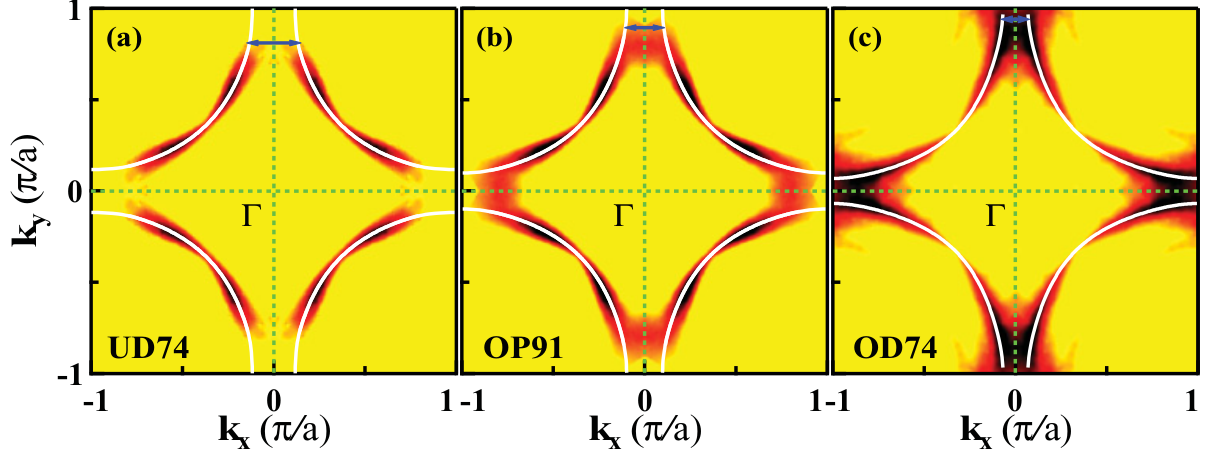
In studying high temperature superconductors, what can be explained by a textbook Fermi liquid theory and what cannot be is a central question. This is generally easier said than done, because an exotic theory can look like a textbook theory when low energy excitations are examined. So, the correct question to ask is whether the exotic strong correlation physics is first or the textbook Fermi liquid physics is first.
In addressing this question, the so-calle Na-oxychloride superconductors (NaCCOC) are valuable. Here in this work, we studied these rarely obtainable high quality crystals at UCSC. The data taken at UCSC definitely indicate that the exotic strong correlation physics is the primary physics to be considered first. This conclusion is drawn by carefully stuyding the Fermi surface geometry and correlating it with the known charge ordering wave vectors for NaCCOC.
Extension to other cuprates
We could also extend our analysis to Bi2212 superconductors, for which we obtained the data at the UCSC, and Bi2201 superconductors. In both cases, we could draw the same conclusion as above.
Relation to the study of strange metal phase
Our studies of the strange metal phase (sECFL, pECFL, nMBDOS) show that the extreme correlation is important. The study of charge order here agrees on that. However, this study is related to the so-called pseudo-gap phase, not the strange metal phase. Of course, the eventual theory of superconductivity should address all phases: the strange normal phase, the pseudo-gap phase, and the superconducting phase.
Links, data
The paper can be accessed from here (PRB, Rapid Communications) or here (public access).
This work was presented as part of my invited talk at the March meeting 2012: abstract and presentation.
- Jianqiao Meng (postdoc), Matt Brunner (grad student)