 Research in the Gweon Group
| Differences between revisions 1 and 20 (spanning 19 versions) | Back to page |
|
Size: 7102
Comment:
|
Size: 1390
Comment:
|
| Deletions are marked like this. | Additions are marked like this. |
| Line 1: | Line 1: |
| ##master-page:FrontPage #format wiki #language en #pragma section-numbers off #pragma camel-case on |
== Electron spectrscopy on novel quantum materials == |
| Line 7: | Line 3: |
| <<h( <span class='floatleft' style='position: relative; top: 15px;'> <img src='Images/Picture 074.jpg' alt="Sam's Picture"> </span> <span class='first-letter'>T</span>his is the home page of Gey-Hong Gweon’s group in the <a href='http://physics.ucsc.edu'>Department of Physics</a>, at the <a href='http://www.ucsc.edu'>University of California, Santa Cruz</a>. Gey-Hong Gweon, assistant professor of physics, is also known as Sam by some students and friends. His name part “Gey” rhymes with “key”, and “Gweon” with “won.” </div> <div style='margin-top: 10px'> This group specialize in the single particle spectroscopy of condensed matter systems, where “particle” means electron. The main technique is the angle resolved photoemission spectroscopy, widely known by its acronym ARPES. Many types of materials are studied by this powerful technique. Currently, the materials of high interest in this group include high temperature superconductors, two leg ladder quasi-one-dimensional cuprates, cobalt oxides, and graphene. </div> </div> </div> |
<<lia("NFL.png", clickable = False, align = left, scale = 1)>> <<fl(W)>>hat is the most central topic of condensed mateter physics? The answer is not unique, since the condensed matter physics is such a huge diverse field. |
| Line 21: | Line 5: |
| <div style='padding: 10px 0 10px 0;'> <table class='innerpage' style='text-align: left;' border=0 cellspacing=0px cellpadding=0> <tbody> <tr style='padding: 0 0 10px 0;'> <td colspan=2> <p> <span class='floatright'><a href='http://www.ucsc.edu'><img src='Images/Banana Slug Mascot.png' alt="Banana Slug" class='noborder'></a></span> Gey-Hong (Sam) Gweon got his Ph. D. in physics from the <a href='http://www.lsa.umich.edu/physics'>University of Michigan</a>. He also worked at the <a href='http://www.physics.berkeley.edu'>University of California at Berkeley</a>, and the <a href='http://www.lbl.gov'>Lawrence Berkeley National Laboratory</a>, before coming to Santa Cruz, to become a Banana Slug (from being a Wolverine at U-M). His science training goes back to his undergraduate years in the <a href='http://phya.snu.ac.kr'>Department of Physics at Seoul National University</a> of South Korea, and actually to his high school years when his enthusiastic physics teacher influenced him greatly. </p> </td> </tr> <tr> <td style='text-align: left;'><address>Email Address: gweon at ucsc.edu</address></td> <td style='text-align: right;'><address>G.-H. Gweon, Assistant Professor</address></td> </tr> <tr> <td style='text-align: left;'><address>Office: ISB-249, Tel: 831-459-1806</address></td> <td style='text-align: right;'><address><a href='http://physics.ucsc.edu' id='quiet'>Department of Physics, University of California</a></address></td> </tr> <tr> <td style='text-align: left;'><address>Lab: NSII-217, 831-459-5119; Fax: 831-459-3043</address></td> <td style='text-align: right;'><address>Santa Cruz, CA 95064</address></td> </tr> <tr> <td></td> </tr> </tbody> </table> </div> >> |
However, one surely exciting thing is that certain well-established textbook ideas, such as the Landau Fermi liquid or the clear distinction between metal and insultor, are severely challenged—so, many condensed matter researcher are very excited about establishing the “physics of tomorrow's textbook.” Here, in the Gweon group, we study to clarify such physics. One is the so-called ''non-Fermi liquid physics'' of high temperature supercondutors and quasi-one dimensional cuprates. Generally, these exotic non-Fermi liquid states can be viewed as one consequence of the interactions of many particles. The other is the so-called ''topological insulator phase,'' which is a newly discovered quantum phase. Materials that we study in the Gweon group include high temperature superconductors, two leg ladder compounds, topological insulators, graphene, and cobalt oxides. All of these can be referred to as “novel quantum materials” in the sense that they harbor the physics of tomorrow. They are also expected to be useful for novel quantum devices for tomorrow. |
Electron spectrscopy on novel quantum materials
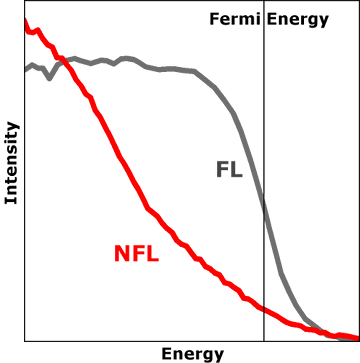 What is the most central topic of condensed mateter physics? The answer is not unique, since the condensed matter physics is such a huge diverse field.
However, one surely exciting thing is that certain well-established textbook ideas, such as the Landau Fermi liquid or the clear distinction between metal and insultor, are severely challenged—so, many condensed matter researcher are very excited about establishing the “physics of tomorrow's textbook.”
Here, in the Gweon group, we study to clarify such physics. One is the so-called non-Fermi liquid physics of high temperature supercondutors and quasi-one dimensional cuprates. Generally, these exotic non-Fermi liquid states can be viewed as one consequence of the interactions of many particles. The other is the so-called topological insulator phase, which is a newly discovered quantum phase.
Materials that we study in the Gweon group include high temperature superconductors, two leg ladder compounds, topological insulators, graphene, and cobalt oxides. All of these can be referred to as “novel quantum materials” in the sense that they harbor the physics of tomorrow. They are also expected to be useful for novel quantum devices for tomorrow.