 Research in the Gweon Group
| Differences between revisions 17 and 20 (spanning 3 versions) | Back to page |
|
Size: 1685
Comment:
|
Size: 1748
Comment:
|
| Deletions are marked like this. | Additions are marked like this. |
| Line 9: | Line 9: |
| ~-The above pretty image is linked from the wikipedia. There is one flaw in this image. UHV means that pressure $< 10^{-9}$ mbar, not $< 10^{-7}$ mbar (<<ln(http://en.wikipedia.org/wiki/Ultra-high_vacuum,this article)>> ''is'' correct. I will leave this image as it is, as I always remind my students ''not to believe everything that they read''.-~ | <<h(<span style="font-size: 83%;">)>>The above pretty image is linked from the wikipedia. There is one flaw in this image. UHV means that pressure $< 10^{-9}$ mbar, not $< 10^{-7}$ mbar (<<ln(http://en.wikipedia.org/wiki/Ultra-high_vacuum,this other article)>> ''is'' correct for this). I will leave this image as it is, as I always remind my students ''not to believe everything that they read''.<<h(</span>)>> |
ARPES
The main technique used in the Gweon group is angle resolved photoelectron spectroscopy, ARPES.
This is a major technique in condensed matter physics. Major contributions from GHG have been made on graphene (the first measurement of the Dirac cone), high temperature superconductors (the first identification of the high energy dispersion anomaly for non-insulating high temperature superconductors; the first study that found a direct isotop-dependent evidence for electron-photon coupling).
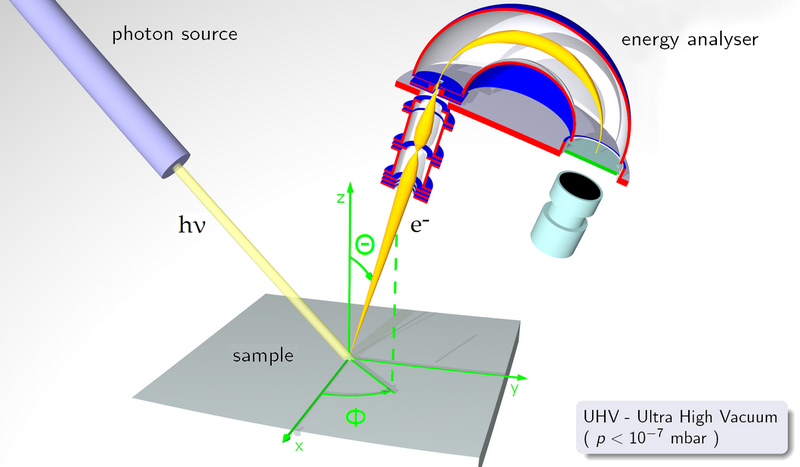
The above pretty image is linked from the wikipedia. There is one flaw in this image. UHV means that pressure $< 10^{-9}$ mbar, not $< 10^{-7}$ mbar (this other article is correct for this). I will leave this image as it is, as I always remind my students not to believe everything that they read.
Here at UCSC, the Gweon group has been busily collecting high quality ARPES data. Also, the in-depth test of many body theories is a major interest of the Gweon group. With data taken at UCSC and theoretical ideas brewed at UCSC, the Gweon group have been able to show the importance of the electorn correlation in charge order formation in high temperature superconductors, the first full description of the nodal cut of high temperature superconductors in terms of the extremely correlated Fermi liquid model, and the discovery of a novel anomaly that points to a class of correct theories for the high temperature superconductivity.
If you like to know more about ARPES, please go here.