 Physics 139B UCSC
| Differences between revisions 28 and 74 (spanning 46 versions) | Back to page |
|
Size: 2921
Comment:
|
← Revision 74 as of 6:11PM, Dec 16, 2013 ⇥
Size: 5280
Comment:
|
| Deletions are marked like this. | Additions are marked like this. |
| Line 3: | Line 3: |
| We have our midterm coming up next Tuesday (Nov 5). This will be the only in-class exam, as the final exam will be a take-home exam. Here are some resources. | * '''Final exam''' |
| Line 5: | Line 5: |
| * <<la("Review for Midterm.pdf", "Summary of the review session (Nov 2)")>>. * In addition to what I summarized here, we also discussed problem 6 of the practice midterm briefly. Here is what I said. The setup here boils down to the initial state at $t = 0$, which evolves in time, according to the Hamiltonian. The time evolution for this Hamiltonian corresponds to the rotation of the spin around the direction of the magnetic field. Initially, the spin is up along the $z$ direction. So, for part (a), there won't be any change to the state (except for a phase accumulation). For part (b), the state will rotate in the $yz$ plane with the Larmor precession frequency. You must do the math to illustrate these points, using the same math that we used in early homework problems. |
* I hope you showed your best in the final exam. Here is <<la("E02.pdf", "the final exam")>> ~-(<<la(E02-w-Sols.pdf, "with solutions")>>)-~. |
| Line 8: | Line 7: |
| * <<la("Last-midterm.pdf", "Last year's midterm exam")>>: There were a bit too many problems. I think this year's exam should be about two problems less. | <<clr>> <<lia("E02-histogram.png")>> <<clr>> |
| Line 10: | Line 11: |
| * <<la("Review-last-midterm.pdf", "The review summary of the last year's review for the midterm")>>. | * '''Midterm exam''' |
| Line 12: | Line 13: |
| == Quiz == | * The exam score was '''235 ± 90 out of 350''' (400, if incl. extra credit). I think this score distribution is quite decent. The exra credit from the forum discussion has not been applied yet. Actually, any one is welcome to contribute more to the discussion and get credits on the pre-midterm problems.—~-''<<DateTime(2013-11-12T16:22:50-0800)>>''-~ |
| Line 14: | Line 15: |
| * '''Quiz 3''', ~-Oct 29-~: <<la("Q03-Symmetry+.pdf", "Virial theorem, Symmetry")>> ~-(<<la("Q03-Symmetry+-w-Sols.pdf", "with solutions")>>)-~ | * If you can describe a new solution that is much simpler, then that will have value to all students—we can remember simple things the best. * Even if this simplifying process depends on an existing solution, it is OK, as long as you assimilate the existing solution and present a clearly new view. * There are problems (8b and 10) that have not been answered. |
| Line 16: | Line 19: |
| * '''Quiz 2''', ~-Oct 22-~: <<la("Q02-Perturbation.pdf", "Perturbation")>> ~-(<<la("Q02-Perturbation-w-Sols.pdf", "with solutions")>>)-~ | * I hope you did well on the exam. Here is the exam: <<la("E01.pdf", "problems only")>>, ~-<<la("E01-w-Sols.pdf", "with solutions")>>.-~—~-''<<DateTime(2013-11-05T16:37:42-0800)>>''-~ |
| Line 18: | Line 21: |
| * '''Quiz 1''', ~-Oct 15-~: <<la("Q01-Formalism.pdf", "Formalism")>> ~-(<<la("Q01-Formalism-w-Sols.pdf", "with solutions")>>)-~ | * We have our midterm coming up next Tuesday (Nov 5). This will be the only in-class exam, as the final exam will be a take-home exam. Here are some resources. * <<la("Review for Midterm.pdf", "Summary of the review session (Nov 2)")>>. * In addition to what I summarized here, we also discussed problem 6 of the practice midterm briefly. Here is what I said. The setup here boils down to the initial state at $t = 0$, which evolves in time, as governed by the Hamiltonian. The time evolution for this Hamiltonian (constant B field coupling to spin) corresponds to the rotation of the spin around the direction of the magnetic field. Initially, the spin is up along the $z$ direction. So, for part (a), there won't be any change to the state (except for a phase accumulation). For part (b), the state will rotate in the $yz$ plane with the Larmor precession frequency. You must do the math to illustrate these points, using the same math that we used in early homework problems, but expect (and confirm) these behaviors. * <<la("Last-midterm.pdf", "Last year's midterm exam")>>: There were a bit too many problems. I think this year's exam should be about two problems less. * <<la("Review-last-midterm.pdf", "The review summary of the last year's review for the midterm")>>. |
| Line 22: | Line 32: |
| * '''Homework 5''', ~-due Nov 12-~: <<la("H05-VP-WKB.pdf", "Variational principle, WKB, Bohr-Sommerfeld")>> | * '''Homework 8''', ~-not due, but must do-~: <<la(H08-Scattering-and-Berry-phase.pdf, "Scattering and Berry phase")>> * '''Homework 7''', ~-due Dec 4-~: <<la("H07-Electron-and-photon.pdf", "Interaction of light and matter")>> ~-(<<la(H07-Electron-and-photon-w-Sols.pdf, "with solutions")>>)-~ * '''Homework 6''', ~-due Nov <<color(21)>>-~: <<la("H06-Perturbation-TD.pdf", "Time-dependent perturbation")>> ~-(<<la(H06-Perturbation-TD-w-Sols.pdf, "with solutions")>>)-~ {{{#!wiki comment * <<color("Correction:")>> Sign mistake in solution (page 8) and subsequent corrections (red).—~-''<<DateTime(2013-11-25T16:17:20-0800)>>''-~ }}} * '''Homework 5''', ~-due Nov 12-~: <<la("H05-VP-WKB.pdf", "Variational principle, WKB, Bohr-Sommerfeld")>> ~-(<<la(H05-VP-WKB-w-Sols.pdf, "with solutions")>>)-~ |
| Line 27: | Line 47: |
| * <<color("Addition:")>> Prob. 1, solution: important discussions of $\hat L^2$ and $\hat p_j^2$ (red)! In the problem, 14 → 15.—~-''<<DateTime(2013-11-04T14:14:26-0800)>>''-~ | |
| Line 40: | Line 61: |
== Quiz == * '''Quiz 4''', ~-Nov 26-~: <<la(Q04-VP-WKB.pdf, "Bohr-Sommerfeld rule")>> ~-(<<la(Q04-VP-WKB-w-Sols.pdf, "with solutions")>>)-~ * '''Quiz 3''', ~-Oct 29-~: <<la("Q03-Symmetry+.pdf", "Virial theorem, Symmetry")>> ~-(<<la("Q03-Symmetry+-w-Sols.pdf", "with solutions")>>)-~ * '''Quiz 2''', ~-Oct 22-~: <<la("Q02-Perturbation.pdf", "Perturbation")>> ~-(<<la("Q02-Perturbation-w-Sols.pdf", "with solutions")>>)-~ * '''Quiz 1''', ~-Oct 15-~: <<la("Q01-Formalism.pdf", "Formalism")>> ~-(<<la("Q01-Formalism-w-Sols.pdf", "with solutions")>>)-~ |
Exam
Final exam
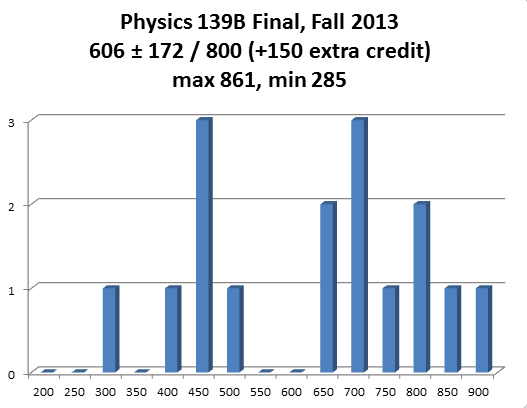
I hope you showed your best in the final exam. Here is the final exam (with solutions).
Midterm exam
The exam score was 235 ± 90 out of 350 (400, if incl. extra credit). I think this score distribution is quite decent. The exra credit from the forum discussion has not been applied yet. Actually, any one is welcome to contribute more to the discussion and get credits on the pre-midterm problems.—5:22PM, Nov 12, 2013
If you can describe a new solution that is much simpler, then that will have value to all students—we can remember simple things the best.
- Even if this simplifying process depends on an existing solution, it is OK, as long as you assimilate the existing solution and present a clearly new view.
- There are problems (8b and 10) that have not been answered.
I hope you did well on the exam. Here is the exam: problems only, with solutions.—5:37PM, Nov 05, 2013
- We have our midterm coming up next Tuesday (Nov 5). This will be the only in-class exam, as the final exam will be a take-home exam. Here are some resources.
Summary of the review session (Nov 2).
In addition to what I summarized here, we also discussed problem 6 of the practice midterm briefly. Here is what I said. The setup here boils down to the initial state at $t = 0$, which evolves in time, as governed by the Hamiltonian. The time evolution for this Hamiltonian (constant B field coupling to spin) corresponds to the rotation of the spin around the direction of the magnetic field. Initially, the spin is up along the $z$ direction. So, for part (a), there won't be any change to the state (except for a phase accumulation). For part (b), the state will rotate in the $yz$ plane with the Larmor precession frequency. You must do the math to illustrate these points, using the same math that we used in early homework problems, but expect (and confirm) these behaviors.
Last year’s midterm exam: There were a bit too many problems. I think this year's exam should be about two problems less.
The review summary of the last year’s review for the midterm.

Homework
Homework 8, not due, but must do: Scattering and Berry phase
Homework 7, due Dec 4: Interaction of light and matter (with solutions)
Homework 6, due Nov 21: Time-dependent perturbation (with solutions)
Correction: Sign mistake in solution (page 8) and subsequent corrections (red).—5:17PM, Nov 25, 2013
Homework 5, due Nov 12: Variational principle, WKB, Bohr-Sommerfeld (with solutions)
Homework 4, due Oct 30: Symmetry, Hydrogren-like atom (with solutions)
Addition: Prob. 1, solution: important discussions of $\hat L^2$ and $\hat p_j^2$ (red)! In the problem, 14 → 15.—3:14PM, Nov 04, 2013
Addition: Prob. 1: some footnote about the mathematical group, since some students asked about it after class.—4:36PM, Oct 22, 2013
Homework 3, due Oct 22: Symmetry+ (with solutions)
Homework 2, due Oct 15: Perturbation (with solutions)
Homework 1, due Oct 8: The basics of QM (with solutions)
Addition: 3(a): “and”—2:28PM, Oct 07, 2013
Change: 6(a): the wave function is → the corresponding state is given by.—10:47AM, Oct 04, 2013
Quiz
Quiz 4, Nov 26: Bohr-Sommerfeld rule (with solutions)
Quiz 3, Oct 29: Virial theorem, Symmetry (with solutions)
Quiz 2, Oct 22: Perturbation (with solutions)
Quiz 1, Oct 15: Formalism (with solutions)